
How to Play Jazz Piano – A Beginners Guide

April 16, 2026
 Alright, so how do you really learn jazz piano?
Since I started this site I’ve received numerous emails from readers asking me the best way to learn how to play jazz piano and how to get started learning jazz as a beginner. Let’s first start with my jazz piano journey to give you an example…
My Jazz Piano Journey
For jazz beginners this beautiful style of music can seem intimidating and hard to tackle.
Don’t worry though. You’re not alone! I remember feeling the same way myself as a young musician while listening to great jazz musicians. I would sit in my basement and just listen over and over again to people like Charlie Parker, Herbie Hancock, Wes Montgomery, and others. How did they play jazz like that??
I was so amazed by how they sounded but I had no idea what they were doing to get that magnificent sound. I constantly wondered where I could I even begin to sound like these guys?
 Now, many years later as a pro musician I look back on those uncertain times and wish I had discovered a clearer direction when I started.
So, in order to help the beginner jazz piano students out on their own path to growth, I’d like to discuss some core components of what you need to begin to play this wonderful style of music.
Hopefully this will give you guys a more focused start on your journey of finally playing jazz piano. This is the starter guide/advice I wish I would have had as a newbie. Let’s get to learning!
Step 1: Learning Jazz Piano Standards – The Start
Being a beginner jazz musician is very similar to being a student learning a new language. Every time you learn a new “word”, or in our case a new chord, lick, or a new scale, it becomes a piece of vocabulary you can then use in a sentence.
Now, of course learning new “words” is important to any language but if you don’t know how to construct and speak a full sentence it will always be hard to communicate.
To continue with our metaphor, learning jazz tunes is the equivalent of us truly being able to speaking in sentences. Once you know tunes then you can apply any new musical idea you learn to jazz songs.
So, the first step should be to spend some time actually learning some jazz music. A good starter point for any new tune is to just start by learning the melody and the chord changes.
Jazz Tune Suggestions To Start With
You can start and learn jazz standards like Satin Doll, Blue Bossa, Misty, Autumn Leaves, All The Things You Are, or Fly Me To The Moon, etc. If you need more ideas of beginning jazz tunes I would recommend you read this beginning jazz standards to learn article.
You should also check out this discussion of jazz fake books where we discuss some of the best fake books to learn from.
 We’ve also created an exciting course that teaches you how to play pro level jazz piano no matter what level you play at. We’ve got the sheet music, video breakdowns, song analysis for beginners, intermediate, and advanced players, jazz theory, jazz chords, jazz scales, jazz chord progressions, hits from the greatest jazz pianists, and oh so much more!
You can explore that course right here.
Step 2: Aural Tradition and How To Learn Jazz Vocabulary
We’ve discussed this before in our switching to jazz from classical article. The approach you take to play jazz piano is very different than classical. All the notes are written out in classical music. In jazz some of the notes are written out but a lot of the style of jazz music needs to be learned by ear and listening.
The true essence of playing jazz piano is transferred by listening and by mentorship. It’s very important that you invest your time into figuring out what you’re hearing.
How To Figure Out What You Hear
Spend time figuring out the things you love on your favorite recordings.
You don’t have to figure out a whole album of material you like. You can start very simple. Just figure out 2-4 bars of something you really enjoy. In a perfect world this would be on a song or chord progression you are already are familiar with.
To help me study things more closely I like to use a music loop and slow down program called Transcribe. I use it on a daily basis and I find it very helpful to study faster or more detailed music at a slower and more manageable tempo.
Listen closely for things like note choices, articulation placement of rhythms, syncopation etc. This kind of stuff can be very different than classical. Especially when it comes to beat placement and where accents are played.
Should You Write Everything Down?
It’s not required that you notate everything you hear to play jazz. But, it’s important that you can at minimum play along with the recording in time. If it’s too fast for you to play along with at full speed use Transcribe to slow the recording down for you.
On a final note, please keep in mind that when you play jazz, rhythm and articulation take on a much greater significance. Never forget that. It’s not just the notes, it’s how you rhythmically play them. As Duke Ellington said, “It don’t mean a thing if it ain’t go that swing!”
Step 3: Jazz Piano Theory Concepts
It is also very useful to spend time learning more about jazz theory. Learn some common chord progressions. Even if you’re not a piano player knowledge of common chords will be very helpful. This is definitely part of core jazz piano basics and learning jazz theory.
Learn some fundamental jazz piano chords and some chord voicings. A good place to start with music theory would be these chord lessons on shell voicings, rootless minor voicings, rootless dominant voicings, or even a I-VI-II-V-I chord progression. You can even start by learning some solo piano chords.
By the way, one of the biggest mistakes that newbies make is to try to play jazz piano from a beginner book. This is a classic mistake and one that will cause a lot of pain and bad habits later.
You never hear of any great jazz pianists who learned how to play from a book. It’s just not how the style is best learned.
 In my Zero To Jazz Piano Hero course we do have lots of sheet music to aid in the learning process. But, the real magic doesn’t come from sheet music, it happens from watching and listening through videos and fun exercises. When you’re having fun with a beginner jazz lesson, you’ll be that much more likely to continue studying with exciting motivation. After teaching hundreds of students privately in the Jazz Inner Circle Program, we know that motivation is huge for beginner jazz players and we want you to succeed as easily as possible. Many students think it takes years and years to learn jazz piano, but the truth is you can learn a lot in 60 days with the right teacher and the right methods.
Step 4: Start To Acquire Some Jazz Vocabulary
One of the best ways to really play jazz piano is to study the licks of master jazz musicians. Jazz is an improvisational art form. So, it’s essential that you learn to improvise over common chord progressions and famous jazz standards.
A good place to start is to learn a few II-V-I (2-5-1) licks. It’s the most common chord progression in jazz.
There are tons of licks from the jazz masters to learn as well. You could start with this Barry Harris lick, or this Bud Powell Lick, a Charlie Parker lick, a Red Garland lick, or even a Bill Evans lick.
Or maybe you want someone to show you step by step how to become better at improvising jazz piano?
We have a step by step course that shows you mind blowing jazz improv techniques. We feature great artists like Herbie Hancock, Chick Corea, Horace Silver, McCoy Tyner and more. You can check out the jazz improvisation course here.
Here’s a sample video from the program.
Step 5: Building Your Own Jazz Improvisation
What do you once you learn some licks and chords? Make sure you spend time figuring out what makes each piece of vocabulary work. How are they built? What are the building blocks? What are the core components?
Get to the essence of each piece of vocabulary. Then, use them as a springboard for coming up with your own licks.
By coming up with your own vocabulary you’re essentially finding your own voice within the jazz tradition.
At its highest level jazz really is about personal expression. So, analyze, understand, imitate, and then reinvent.
I always recommend you start to learn jazz improvisation by listening to the jazz piano legends like Herbie Hancock, Bill Evans, Oscar Peterson etc. etc.
If your musical ear isn’t great yet but want to learn how to play like them and up your jazz playing we have you covered. You can check out our step by step courses right here. We’ve got a great beginner jazz course and our Premium course which includes tons of video breakdowns of the best jazz chords, jazz theory, jazz music, ear training tips, jazz foundations, and so much more! It’s safe to say, you’re in for a treat. Welcome to jazz piano and enjoy the ride!
*******
Now that you’ve made the great decision to learn jazz, what will you jump into 1st? If you’re already have some experience what will you learn next? Did you enjoy this intro to jazz piano? Please leave a comment below and let us know!
If you are new here please remember to subscribe to the free jazz lessons email list right below this article. You’ll be receive all the latest and greatest jazz piano lessons right in your inbox. We look forward to helping you study and perform for many decades to come. Thanks for reading!
How To Learn Jazz Songs The Right Way
Today we’re going to talk about one of the biggest mistakes that beginner jazz piano players make when they learn jazz standards.
By the end of this short lesson you’ll know how to learn jazz songs on a much deeper level.
Let’s get started learning (video, notation, and tips below).
The Fake Book Dilemma
If you’ve recently sat down to learn a jazz standard you’ve most likely used a fakebook.
Fakebooks can be a useful tool in certain ways.
But, if you’re using a fake book as your ONLY tool for learning a tune you’re making a classic beginner mistake.
The problem is that most fake books are missing an incredible amount of information.
You’ll rarely see all the hip voicings, chord changes, reharms, and rhythms that you’ll hear pro level jazz musicians playing.
The stylistic stuff that actually makes a tune sound interesting just isn’t written in there!
Ugh. Who wants to play a boring version of a tune? Not I said the fly. 🙂
- So, how can you start filling in the gaps that jazz fake books leave?
- How can you actually start playing jazz songs the way they’re really meant to be played?
- How can you really unlock some of the incredible sounds you hear your favorite jazz piano musicians play?
There is a solution…
Hearing Changes Everything
Jazz is ultimately an aural art form. Most of the jazz style is learned by listening to other great musicians and also watching what they do.
Since fake books really only tell a tiny portion of the story you want to make sure you’re not turning to them as your first step for learning.
 Your real first step should be listening to a great example recording of a tune and studying what you hear.
Now, I’m not talking about having music on in the background while you do dishes or read the news on the internet.
No, I’m talking about a special type of listening.
The unique type of listening that pros do when they learn from recordings.
Whether it be through listening to classic recordings, watching my jazz piano tutorials (Autumn Leaves), or studying with a teacher, you’ve got to get your ears involved in the process right from the beginning.
So much of the true richness of the jazz style will not be found in your fake book!
If you’re not confident in your ear yet. Don’t worry. I’m going to help you through the process of learning through your ear right now.
An Example Video Using Autumn Leaves
So, to help you understand this process of learning through listening lets look at an example chord chart and then a video demo.
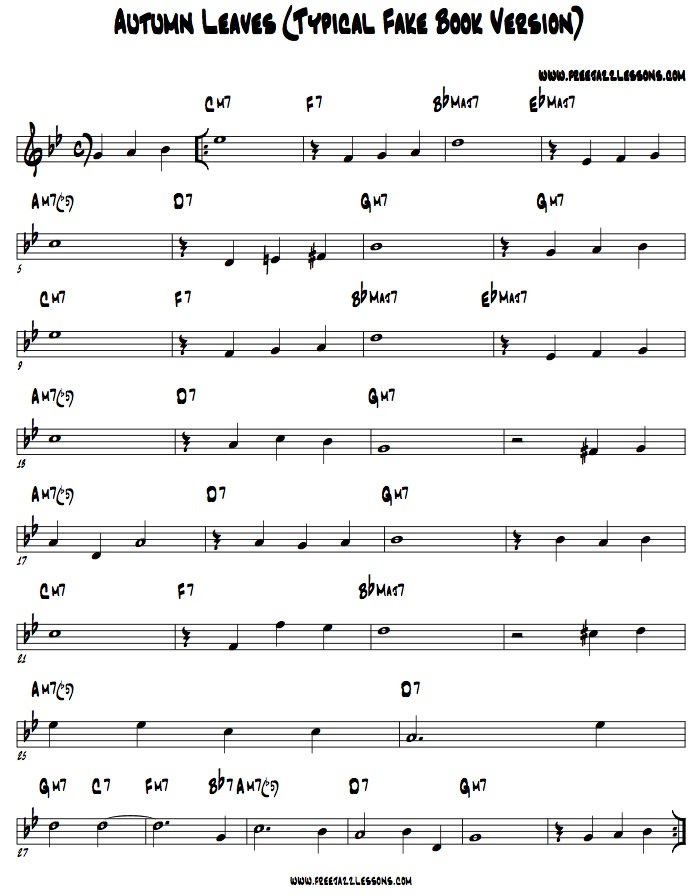
Below I’ve included a typical bland and boring chart for the jazz tune “Autumn Leaves”. This is how it’s notated in the vast majority of fake books.
Check out how:
- The melody is written with every note on the downbeat (no swing and groove).
- The chords don’t have any sophistication written in there (no 9’s, 11’s, 13ths, etc).
- There aren’t any comping rhythms written in.
- There aren’t any arrangement tips.
- No cool voicings suggestions in there either. Just basic chord symbols.
All you have is just a plain and vanilla reduction of the tune.
Then, compare it to the video below. (Feel free to grab some of the chords I teach in the tutorial too!)
Now, this time watch this video of me playing an arrangement of Autumn Leaves.
(This video is a small excerpt from my Premium Jazz Lessons Membership Course.)
Notice how just by simply exercising your listening skill you start hearing all kinds of new possibilities on Autumn Leaves that you didn’t really hear before by just staring at the sheet music.
- Can you hear what happened when I added syncopation to the melody? The swing feel increased significantly.
- None of that rhythmic stuff is in the fake book.
- Can you hear how adding 9’s, 11, 13ths, and other alterations made the chords sweeter and richer sounding?
- Unfortunately, none of that is written in the fakebook.
- Can you hear how adding reharms and additional chord changes in there gave the tune more of a fuller sound?
- Sadly, none of that is in the fakebook either.
All you did was watch a video 1x and the black and white ink on the fakebook chart came to life. 🙂
Just imagine what would happen if you took this listening/watching approach for now on all your tunes.
How much time would it save you? How much cooler would your arrangements of tunes sound?
Want to learn how to play Autumn Leaves like the professional jazz musicians do? Check out our 7 day challenge designed for piano with short daily lessons. We have 3 levels for all musicians (beginner, intermediate, and advanced). Start practicing the classic, Autumn Leaves on the piano no matter your level!
14 Things To Listen For
So, how do you learn by listening to recordings or by watching videos? How can you extract important details you can add into your own playing?
Here’s a basic list of things I’m listening for when I check out a recording of a tune.
- How does the artist phrase the melody?
- Are they adding a lot of syncopation?
- Are they changing the rhythm of the melody?
- Do they play the melody legato, staccato, laid back, aggressive?
- Do they decorate the melody? If so, how (chromatic notes, change certain pitches, grace notes etc.)
- Are there any cool chord substitutions they’re using?
- What piano voicings are they playing?
- Are they staying true to the original chord changes?
- Are they adding any extensions to their chords?
- Are they playing small chord voicings or large chord voicings?
- How is the piano player or guitar player comping behind the melody?
- What kind of rhythmic feel are they using on the A section?
- Do they change the rhythmic feel on the B section?
- What range on their instrument are they playing the melody?
Most importantly, how does the performance differ from the fakebook?
When you can start answering these questions you can start unraveling the ‘mystery’ of what makes a beautiful jazz performance.
You can then take those discoveries and add them into your own playing!
Your Next Steps Going Forward
Learning jazz piano through listening is a skill just like everything else. You can absolutely make a huge impact on your playing if you listen the right way though.
As a fun assignment I highly recommend you take a new tune and find an audio recording or video recording you really enjoy. Take the list from above and really get into the recording.
Listen to the tune several times and take some notes on what you hear using the list as your guide.
Then, go ahead and sit down at the piano and try out some of the discoveries you make. I highly encourage you to copy the “listening list” from above and print it out.
Always remember the more you put into this great art form the more it will give you in return. Enjoy your practice!
If you have any questions or have some more ideas you’d like to add to the listening list please feel free to leave a comment below. It’s always nice to hear from you!
Sincerely,
Steve
P.S. If you need more help learning tunes and chords I encourage you to check out the over 16 hours of videos in my Premium Jazz Membership Course.
photo above courtesy of fever blue on flickr
7 Tips For Playing Better Jazz Piano

World touring jazz pianist Steve Nixon’s tips for playing great jazz piano.
1) Your chords have to be 100% authentic in the jazz style
That means using chords that contain the prettiest notes. If you only play triads and basic chords you’re missing 99% of the style.
As far as jazz piano tips go this is a huge one!
You don’t want your playing to sound cheesy right? Great jazz chords must contain notes like the 7th, 9th, 11, and 13th. They should be balanced properly with the right note order too.
2) Learn the 7 most common chord progressions in jazz
 Jazz is a style of music that features many of the same chord progressions over and over again.
Instead of looking at every chord individually it’s critical that you start seeing chords as patterns. This will set your playing free. That’s because these 7 jazz patterns are in 99% of jazz tunes. Learn them and watch your playing skyrocket.
In fact, the reason I can play piano jazz arrangements quickly and instantaneously is because I see everything as patterns.
3) You must learn how to take a great solo on every song you play
Jazz is a style that’s filled with improvisation. It’s at the very core of the genre of music. So, it’s expected that you know how to take a great solo on every tune.
4) You must use authentic swing rhythms in your playing
Jazz is a very rhythmic style of music. There are classic rhythms that every great jazz pianist uses in their playing. They’re syncopated and groove like crazy! If you play everything on the downbeat you’re missing a big part of this style.
5) You must substitute your own unique chords into every piano jazz song you play
If you want to avoid the pain of sounding like a total newbie you should absolutely be changing some of the chords in your songs.
Don’t sound like a million other wannabes. Be you! Audiences love it when you can insert unexpected and hip chords into your songs.
 6) Memorize the patterns, chords and melody for every song
If you’re just playing off sheet music you’re missing 99% of this style of music. Playing stock arrangements off sheet music is not really playing jazz.
It’s the same thing as you reading someone else’s words and saying that they’re you’re own. Now, I understand that it’s not always easy for people to come up with their own piano jazz arrangements.
Fortunately, there is a fun course that teaches you how to build your own jazz arrangements. They sound fantastic and after going through the course you’ll be able to play piano jazz arrangements and songs like the pros.
7) Model the playing of proven jazz masters
I’m talking about people like Herbie Hancock,Chick Corea, Oscar Peterson, Diana Krall, Ray Charles, etc. There’s a reason why millions of people LOVE their playing. Success leaves clues.
People who succeed consistently are not lucky; they’re doing something different than anyone else. These legends have a playing strategy that works and if you follow the same proven strategy then you’ll reap the same rewards.
That’s why I always recommend people follow a system that teaches how to play the same classic chords, licks, songs, and rhythms that the legends use. If you want a big collection of thousands of my best piano tips and tricks, amazing insider tutorials, MIDI files, and more this is for you.


Good advice, Steve. Sometimes it is hard to sort out so much information that I think it is too much to learn and then goes away the stimulus. But I will try this guide. Thanks.
My pleasure!
I started out with a simple book-Play piano in a flash- and as you said you learn the melody to a favorite song and then the chord changes, put them together and suddenly you are playing the piano ! After that it is up to you how far you want to go. You will need to learn the scales and how to play in all 12 keys. You need to know the ii-V-1 progressions. Take one song and learn to play it well; then, go from there.
Thanks steve
No problem Luke. Have fun with this stuff!
Thank you for your advice. I’m taking this post as a starting point to begin working out jazz piano.
My pleasure Xavier!
I have always wanted to learn jazz.. I feel overwhelmed I just need some guidance to get started.. I am 37 felt it was late but no its not.
As long as you’re committed to improvement and enjoy the practice you’ll be able to progress at any age.
Hello Steve
just joined your lessons and I’am fascinated
I started playing piano from scratch 4 years ago (at my 65 th year) and followed classical tutoring, yet being an jazz addap,t I started download score sheets with just the chords plus text and the melody line, of many classical songs and ballads out of mainly the 50thies
So I do know a lot of chords by now, but did not see always the connection and or the width of a chords range. I do write out the complete left hand and try to place and break the chords into a nice rithem, I find that sometimes hard . I play by now songs like: misty , nobody knows you when your down and out , Into each life some rain must fall and so on. I hope to learn a lot from you and look forward in receiving some advice
kind regards
Bert
Welcome Bert to the community here!
Hello Steve
am sandesh from Nepal. Could you please tell me more more chord progression other than II V I, and can i used same scale for the whole progression,Right now am using G major Scale (Am7-D7-Gmaj7) and i replace D7 with Ab7 which is tritone is that right?
wow, i stumbled upon your site today while practicing my trombone. I have been stuck playing notes on the page for 40 years and want to break out of that. I have ideas but don’t know how to get them out of my head. this might be the ticket!
Hi Mark,
There are a ton of lessons on improvisation on this site. Welcome to the community here. Happy to have you!
Thank you for the excellent material! I’m brazilian and started to listen, practice and love jazz songs!
My pleasure. Jazz is a lot of fun and I’m sure you’ll fall in love with the style.
Hi Steve,
I started learning piano a few years and have learned some of the standards. I’ve listened to the whole spectrum of jazz players and I feel most interested in the work of Bill Evans. I’m hoping to learn some of the complex harmonies he crafts so well. I just found this site yesterday and it looks like there is plenty of helpful material here.
Thank you so much for this resource.
Jude
Welcome to the community here Jude! Glad to have you. Yes, Bill was one of the all time greats. His harmonies are unbelievable! There’s some free lessons on Bill’s playing on the site as well as a section on him in the Jazz Masters Method DVD. Thanks for leaving a comment and welcome again!
Hai Steve, I’m a newbie in this “jazz world”, and I’d like to know what should I do to learn many crazy jazz chords. Playing jazz sounds interesting and I hope i will be able to do it. I’m 15 years old and I’m studying classical piano. I’m not a pro, so please teach me… 🙂 thank u…
Welcome Jecha! There are a lot of great chord lessons on the site. Use the search bar on the site and type in chords. That will help you alot. Also, if you’re on the email list you’ll receive several chord lessons in your inbox.
Hey Steve,
Some time ago you were writing about learning extended chords (like Maj13#11 etc). You’d suggested the reader to record those chords and then put it on a mp3 player for example. This looks like a very helpfull tool to me for learning to hear the more extended chords with more tensions and alterations. I’m gonna record those chords in cubase using MIDI and a piano VSTi. But now i’m wondering; how do you suggest me to record the chords…. I mean when you play for example Cmaj13, do you take ALL the chord tones C E G B D F A or do you leave some notes out? Like the 5th…. What do you think is the best way to record this for the purpose of learning the ‘sound color’ of those chords? (I mean all chords…. maj, dom, dim, etc) I can hear all triads and 7 chords, but have never practiced more extended chords. Yeah, I can hear the Dom7b10 chord but that’s the only more extended chord I can hear now haha
Hope to hear from you! If you want I can share the files with you to put on your website.
Kind regards,
Tom
Hi Steve, I am Andrew from South Africa. Coming across your FREE JAZZ LESSONS, my long held wish came through. I will make it come true through your lessons.
Great to hear Andrew! Welcome to the site. Happy to have you here.
Thank you for the lessons I will now embark on my musical journey, and have hours of endless enjoyment.
Hi Steve, I am 19 and I’ve come a long way going through my music periods. The Beatles -> Classical -> Rock -> Metal -> Alternative rock -> Alt pop/indie -> now Jamie Cullum and now straight into jazz, I feel very relieved that I found this website. I will go directly into this atmosphere as Jamie has moved the Jazz pop artist inside of me, and I hope to evolve into something deeper theoretical jazz :))
Thanks Alot Steve
Awesome Vincent. Sounds like quite a journey so far. We’re happy to have you here as a member of the community. Please feel free to share the site with your musician friends.
Hi Steve
Always wanted to play piano. Finally teaching myself with basic adult piano course bypalmer, manus etc. however my true motivation is to learn to play jazz in particular piece peace. Should I just listen to that and learn that? Or continue learning chords. But I ultimately want to play jazz piano. Can you advise me please?
You should work on chords and your piece. The more skills you have the more you’ll understand this style.
Hi Steve. I’ve been listening to Pat Flynn and loved your intereview. I’m a drummer trying to get the online thing sorted but in my spare time (Currently 30 mintues a day) learning piano. My dream is to write a latin jazz album where I’ll piano and drums. I’m still at the beginning with the piano but it’s good to know I have you to fall back on when I’m ready
Cool Kyle. Nice to hear from you and welcome to the community here!
Hi steve, so I’ve been listening and playing the piano for years..recently I made the decision to focus on Jazz and make it a lifestyle therefore I want to start over, I know about chords, progressions, quite a few scales but I wanted to start again from fresh….any idea as to what I should start with first? Should I start with scales, chords then progressions ? what order would you suggest for someone who wants to progress more and more in jazz with UNDERSTANDING of what they are playing? Thanks
Hi Artemas,
Welcome to the community. You’ll want to really make sure you’re focusing on the topics mentioned in this article. Also, check out this guide I wrote. https://www.freejazzlessons.com/jazz-practice-guide-1/ thanks!
Hi Steve,
I love the piano and I am mainly a singer but I really would like to learn jazz piano. I play the piano by ear and I bearly read the notes. So I would like to know if I should start from the boring solfeggio or there is a new jazz approach by you to learn?
Hi Lous, Keep studying the lessons on this site. There is a lot of patterns you can learn by using your ear and developing your understanding of music theory.
Hi Steve, my name is Nataila and I am a singer-songwriter. Piano to me has always been someone who can help me be in harmony with my feelings and it does this by suggesting the chords and the tunes to me. Lately I have discovered that i have a jazz and blues soul, although I have never played this kind of music before. I can easily improvise but I really want to root this feelings of mine into something more “real”. So I found your lessons. And I am really grateful for this. Thank you Steve 🙂 So much!
Awesome Natalia! Thanks for telling us more about your background. Welcome to the community!
Hey Steve
I am in need of learning the piano i love it i’ve loved it ever since i was about 6 years old so i need to learn the piano and i ham hoping this site can teach me! 🙂
Hi Natalie, welcome to the community! There are a ton of piano resources here to learn from. Enjoy!
Steve,
I’m Josh, senior in high school, raised on classical Piano, but over the past two or so years, have become really interested in Jazz.
It’s really, really cool to know that there are professional musicians, like yourself, out there who are willing to invest in the next generation of jazz musicians at no cost. I know that your knowledge and experience will be a tremendous help in my journey into jazz, and I speak for my generation and the entire jazz community when I say, from the bottom of my heart, thank you.
Hi Josh,
Great to hear that you’re getting into jazz. I love hearing from younger musicians who take an interest in this fantastic art form. You have a fun journey ahead for you. Welcome to the jazz piano community Josh!
Nice article. I play mainly in Neo Soul genre which uses a lot of Jazz Chords. This is very usefull.
Glad you found it helpful Adrian. Neo soul and jazz are good friends 😉
Hi Steve,
For the past twenty years I have performed 40’s Pop and Standards using backing tracks while soloing with sax. Now I would like to write and perform my own music in those same styles. My piano playing is very limited as I have used it not as a performing instrument but as a chord finder. Would you suggest I go about this by learning to play Standards then adapting the voicings I learn to my own melodies, use a theory based approach, or is there another way? Thank you.
Hi Mike,
Thanks for telling us about your background! Learning standards are a fantastic way to learn about jazz as a whole and apply the chord concepts you are discovering. I noticed that you just subscribed to Premium Membership as well so there are a tons of standards and chord lesson for you to explore in there. Plus, all the jazz theory is broken down in each lesson. Have fun and welcome to the community Mike!
Hi,
I have loved jazz since a teenager in the (now 70) but am not a musician and do not pretend to understand the notation. That said, I find the videos very interesting. I like seeing the keyboard along with the explanation and it does give me some insight into the music I love to listen to. Thanks – I’ll continue to explore the videos and hopefully become a more knowledgeable listener.
Fantastic to hear William. Welcome to our community here. Be sure to tell your friends and have fun here 🙂
Hi Steve, I am a completely self taught guitarist and from a blues, classic rock background, I now know a lot more than I did when starting out many years ago, such as building chords and scales, however my dream is to truly play Jazz fluently on guitar, I am struggling to grow in this area as no one really will offer any help and I don’t have the benefit of having a music school or college to go to. I hope you can help point me in the right direction, how many years does it take on average to develop this art form to a professional level?
Hi Dexter,
Welcome to the community here. I get asked variations of this question often. The answer will be different for everybody. It really depends on how hard you’re willing to work. I’ve seen people get real focused and acquire the tools they need to start playing gigs after just a few years. These musicians were dedicated, focused, hungry, and most importantly they loved jazz. Some people don’t work very hard and make lots of excuses. So, it takes them longer to get their skills together. I wish I could say it will take you ‘x’ amount of time but it ultimately it depends on how hungry you are to achieve your goals.
Personally, I love jazz and have been fascinated with this style of music for over 2 decades. So, I never minded putting in the study time because the rewards were plentiful for me on a spiritual and discover of self level. As a result my progress moved very quickly and started gigging fairly quickly once I decided to get my act together in the practice room.
Thank you Steve, I appreciate your response greatly, I am willing to dedicate the time, I just need to know what steps to take? what/how to practise? etc..I can see your guidelines up top, will work on those things as well.
Hello,I am trying to learn music and I am creating a game that needs jazz, its a 50’s types Diner. so how shall I do this?
I’m not 100% sure if I understand your question but if you need some music suggestions check out Dave Brubeck, Miles Davis, John Coltrane, or Thelonious Monk. The work they did in the 50’s is incredible.
Really enjoying & appreciating your lessons,thanks a lot!!!
Thanks Milan!
Hi steve, im new in jazz, but I wonder if a blues extensive knowledge is necessary to develop a language in jazz. Your classes are masterful, i wait your answer! 😀
Thanks Paul. Blues and jazz can be very good friends but sometimes the language is different. The more you learn about music the better you’ll be in both styles though.
Hi, Steve,
I’ve been looking for jazz and blues lessons. It’s hard to find, even in Boston where I live. My current teacher is fine when I am able to play a song, but when it’s bad, he just says, “Work on it some more and I’ll listen next week.” What I really need is step by step guidance as to what to practice and in what order, to build upon things. I plan to try out the free lessons and materials, and likely sign up if it is helpful! Thanks for the useful information!
Paul H.
My pleasure Paul! Not every teacher is organized unfortunately. I look forward to sharing music with you further!
hi steve am michel from Cameroon, ive learned the various modes, but am still confused on how to use them and the various chords to use them with; am stil a begginer, am really interested in jazz music
nice one bro
Thanks.
Sincerely,
Steve Nixon
*freejazzlessons.wpsc.dev *
Steve, picking up Piano again after a 30 year layoff. I can still read music fine, but my fingers have forgotten how to move around the keyboard. Do you have any suggestions on where to begin? Looking for a little structure to organize my practice sessions. Thanks.
Congrats Steve! I’m excited for you. If you’re not already on our email list we have a beginner intro series…I’d jump on that. If you want an actual course with goals and a step by step program than you can check out the Premium Membership course. freejazzlessons.wpsc.dev/premium There’s materials in there for all levels of players but I’ve thrown a bunch of videos in there to help beginners succeed. Of course lots of free sample vids on the site as well that you can peruse around.
Steve,
I’m a musically inclined beginner who happens to be on the north side of 60. At this point I’m only interested in jazz because it’s got that “swing” that we all like.
Your site is absolutely wonderful because of the value that you provide with so many directions to go. My only problem is figuring out where to start and build from there in a disciplined manner without sacrificing the fun of this wonderful music.
Cheers to you and your guidance for the rest of us.
Dennis
Thank you Dennis! Glad to help you grow your skills and yes the swing feeling is infectious. Welcome to the community and look forward to your growth as a player!
Hi Steve, Im just about to buy a piano, what do you think about digital pianos? Does it have the same feeling/sound as the regular ones? Thank you for your help!
They do not have the same sound and feeling. Acoustic will always be a different experience. That being said, you can get some really good digital pianos that get about 85% of the way there.
Thank you for your help! I ll go for the acoustic one then. Can not wait to start your lessons.
Hi Steve,
I’ve played music for many years-classical/pop, read well, composed a lot, and have a good instinct/excellent feel for jazz playing, but i’ve never formally learned it-do know basic theory and more “normal chords”. I would like to know which course i should start with so i can put some order into all this? thanks.
Hi Riva!
Thanks for your comment and congrats on making a decision to improve your jazz skills. How exciting! I would recommend my Zero To Jazz Piano Hero Program freejazzlessons.wpsc.dev/beginner It’s a great fit for students who want to build rock solid jazz fundamentals in a step by step fashion. Plus, you can learn chords and songs you love in 30-60 days. Thanks and I look forward to sharing music with you further!
Hello Steve. I’ve just read this page with interest. Have played since 11 years of age. Piano and Hammond organ. Went through to grade 7. Able to improvise etc. But my mind is somewhat blocked when listening to wonderful jazz piano – asking myself ” is this something i could achieve? “. I guess ive been so locked into classical and church type music. Strange but them heartened how you said you felt. Semi retired now with lots of time. I felt at home with this page and wish to pursue. Interesting seeing others comments too.
John – Oxford UK
Hi John!
Thanks for your comment. This is going to be an amazing time for you. So many cool things to explore in the jazz piano world. Keep us posted on your progress and congrats on the semi retirement. Sounds like you have some time to practice which is awesome!
Hello Steve,
My name is Josh am all way from Tanzania. I started learning how to play piano last year and right now I am a little advanced in playing it though not that much to be called a pro.
My question is, are sure I can start learning jazz lessons and play them well despite of time I am having ever since started to learn how to play piano?
Hi Josh,
Welcome to the community. Yes, anybody can learn jazz piano. You don’t need thousands of years of experience 🙂 You just need to follow a smart plan. That’s why I created this website and all my courses. Thanks for your comment and welcome to the community!
Hi steve, Thanks for this tutorial, by the way I am an online piano teacher, I have 10 students, I will teach them this tutorial.. thanks..!
Cool Nataly. Happy to help and thanks for the comment!