
Dominant Jazz Piano Chords – The Ultimate Guide

March 25, 2026
Hey there! Welcome to this free jazz piano chords voicing tutorial. We’re going to explore some must know dominant jazz chords today. Happy to have you hear with me!
In today’s video lesson I’m going to teach you 5 dominant jazz piano chords that everybody piano player must know. We’ll offer cover some piano jazz chords basics too.
These 5 voicings will work in hundreds of tunes. You can use them for solo piano, playing behind a singer, or even in comping situations. They’re versatile and definitely what I’d consider “bread and butter” voicings.
 I just got home from a 3 week tour. I’m really happy to be home! So, I wanted to share with you a little ‘home from tour’ gift from me. 🙂
Let’s get started learning these new chords right now! Once you watch the video make sure you scroll down for some very important tips.
5 Dominant Jazz Piano Chords Video
Take 5 minutes and watch and listen as I demonstrate the chords. I also break down the music theory of each chord and demonstrate them over a simple chord progression too. 🙂
One you finish the video scroll down for some very important tips and the notation.
Jazz Chord Mastery – 9 Starter Tips
1. The vast majority of time basic jazz piano chords will contain a root, a 3rd, a 5th, and a 7th. If you’re not sure how to figure these piano chords in a fast way then check out this beginner jazz piano course.
2. Once those basic notes are in place we’ll add usually add on 1 or 2 ‘spice’ notes called extensions. Those are the ‘money’ notes so to speak and really make your chords sound rich and beautiful.
3. Every voicing in the video above contains at least 1 extension of the chord. The first 2 voicings contain 1 extension of the chord. The last 3 contain 2 extensions of the chord.
4. Simply put, an extension of a chord is either a 9th, an 11th, or a 13th.
The Perfect All In One Solution
5. The left hand of each of these chords is just a root and seventh. This is pretty much the basic concept behind a shell voicing. Jazz piano master Bud Powell used these type of chords extensively in many tunes!
6. Want to learn how to apply these chords to actual tunes?
There are tons of chord tutorials inside the Premium Membership Course that shows you how to do that.)
7. Notice how the chords that have altered extensions have such a strong need for resolution?
Using altered harmony is almost a secret weapon when trying to create a sense of tension in release in your music.
8. Any of the chords here that have altered extensions will sound great either resolving to a major chord or a minor chord in a V-I chord progression or a 2 5 1.
9. If you want to use these chords in a II-V-I chord progression you’ll need to learn some other chords voicings.
For example, learning more voicings for major piano chords, minor piano chords, and half diminished 7th chords will be very helpful for you.
Sheet Music For The Chords
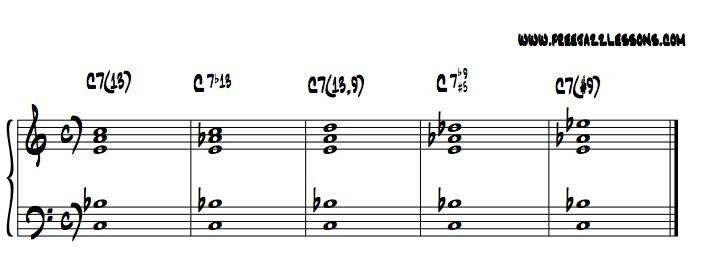
(Click to expand. Feel free to share online. The only thing I ask is you credit freejazzlessons.com with a link back to the site if you do. Thanks.)
9 Jazz Theory Shortcuts
It’s important that you understand the role of each note inside each voicing. That’s how you’ll get really good at throwing these 5 jazz piano chords into tunes and quickly transposing into all 12 keys.
When you can instantly play these chords in any key, you’ve unlocked an essential piece of freedom for yourself at the keys.
So, here are some guide points that you’ll want to be able to recognize as you go through this.
- Can you see how each one of these jazz piano chords have the root and 7th on the bottom? If not, start working on this jazz theory skill asap!
- Do you also see that the 3rd is the lowest note in the right?
- Can you see that the next note up is the 13th of the chord? Sometimes this chord extension is a natural 13th and sometimes it’s a flat 13th (like we discuss in the video).
- The 13th is a note that sounds fantastic on dominant chords. For example, check out this 12 bar blues piano tutorial to see how to use the 13th as a sweet sounding decoration.
How Melody Helps You Pick The Perfect Chords
- Can you recognize quickly that the melody note on these chords is either a root, a flat 9, or a regular 9.
- It’s important to think about how the melody relates to the chord. As a matter of fact, every chord you learn should be thought of as just a harmonization of a melody.
- Want to see the power of learning these type of jazz piano chords on any key? Check out this video now.
- 1 of the best ways to begin reharmonizing your piano songs and to learn jazz standards. is to learn voicings for every note of the scale. Even better if you can do it for all 12 notes. Check out this harmony theory lesson to learn more.
- Organizing your voicings in terms of scale degrees is how pro pianists think about jazz piano chords and harmony. Still getting used to scales? Check out this in-depth lesson on jazz scales.
7 Types Of Chords You Need To Know
In the video for this lesson we’ve explored variations on the dominant seventh chord. This type of chord is the lifeblood of jazz harmony. It’s important to point out though, that there are actually 7 main types of jazz chords you need to explore.
Some are more popular then others but it’s important that you start with a comprehensive list like this. Here they are:
- Major 7th chords.
- Minor 7th chords
- Dominant 7th chords
- minor 7(b5) chords
- Diminished 7th chords
- Major7 #5 chords
- Minor (maj7) chords
If you’re a jazz piano beginner, then you’re in luck.
We have lots of courses that break down these piano jazz chords, the jazz theory behind them, and how to use them in real songs. You can check out a big list of our popular courses right here.
What If You Are Beginner To Jazz Chords?
If you’re brand new to piano jazz chords lets help you get some of music theory fundamentals under your hands.
First of all, there are common patterns that you’ll see inside your jazz tunes.
To help you learn this lets begin with a major scale and build a chord on each note of the scale.
In jazz we tend to use 7th chords as opposed to triads. So, lets build a 7th chord of each degree of the major scale right now.
- 1st scale degree: major 7th chord
- 2nd scale degree: minor 7th chord
- 3rd scale degree: minor 7th chord
- 4th scale degree: major 7th chord
- 5th scale degree dominant 7th chord
- 6th scale degree: minor 7th chord
- 7th scale degree: minor7b5 chord
Here’s A Good Musical Example For You
Here’s an example of how this would look in the key of C:
The C major scale is C-D-E-F-G-A-B
So, in that key the 7th chords would look like this:
- 1st degree: C maj7
- 2nd degree: Dm7
- 3rd degree: Emin7
- 4th degree: Fmaj7
- 5th degree: G7
- 6th degree: Am7
- 7th degree: Bminor7b5.
Remember you can apply this musical formula to any key you’re in.
In fact, a great exercise is to practice this jazz chord piano exercise in all 12 keys.
1 More Tip To Make Jazzy Piano Chords
Another fun you can do is take basic triad chords and make them sound jazzier.
All you have to do is add a 7th on there and it can completely transform the mood and feeling of a song.
For example, lets say a songs chord progression is this:
C Am F G.
To make it sound jazzier you can change the chord progression to this:
Cmaj7 Am7 Fmaj7 G7.
Jazz Chord for the Left Hand – Lesson and Video
In today’s free jazz piano lesson we are going to take a look at a very simple yet very powerful jazz chord. This particular lesson will focus on a rootless dominant seventh chord voicing. (video lesson and notation below).
(This is a follow up lesson to my rootless minor chords lesson. That lesson has been one of my most popular so far and by far the most popular Youtube video I’ve created. Be sure to also watch that one.)
As a reminder, rootless chords work great in many situations. For example, you can use them to comp behind yourself while soloing in a trio. They sound fantastic when a bass player is laying down a root below you. Bill Evans made this approach famous among many other ways of playing chords.
You can even hear modern jazz piano players use them at times when playing solo piano. Sometimes I’ll also play them in my right hand when I’m playing a more complex left hand part or when I’m accompanying a singer. They’re unbelievably versatile! (If you want more solo piano chords also check out this article solo piano chords)
Let’s take a look now at how to play these special chords.
Chord Construction and Notation
Here’s the voicing when played in the left hand.
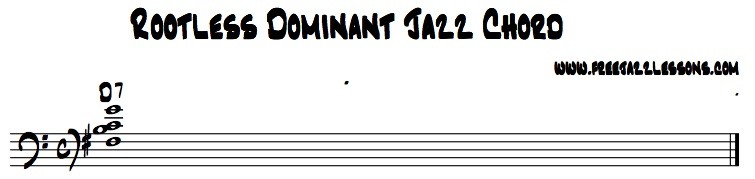
We have the 3rd on the bottom, 13th, then the b7, and the 9 on top.
Here’s the voicing when played in the right hand.
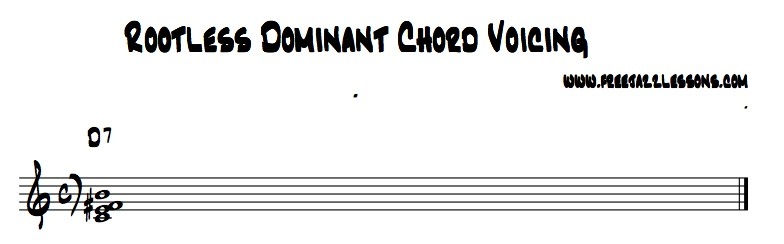
We have the 7th on the bottom, 9th, then the 3rd, and the 13th on top.
Make sure you learn these voicings in a number of keys (preferably all 12) and definitely throw them into to your favorite jazz tunes.
If you enjoyed this free jazz piano lesson please leave a comment below and/or sign up for the free jazz lessons mailing list.
We’re Growing!
 Before I sign off here and you go practice these dominant chords, I’d like to share something that I think is pretty cool.
Earlier today I looked back at the post I wrote a year ago (Why Do You Play Jazz? Finding Your Motivation As A Jazz Musician).
For fun, I also looked back at some of the website traffic numbers that FJL was getting 2 years ago and than compared them to today’s numbers.
Now, I knew the site had grown but I had never compared it to where we were a year ago. My jaw dropped when I took a look...
Want To Join A Community?
The number of regular readers of FJL blog has literally grown by over 400% in just 1 year. Also, the # of people who have subscribed to the Premium Jazz Lessons Course has grown by over 500% in 7 months.
I’m simply floored by these numbers and humbled that I have the opportunity to share music and jazz chords piano lessons with so many people. You all are amazing!
If you’ve been a regular reader of the site for a long time or have been a reader for a few months I’d like to thank you for your support!
If you’re new reader or today’s your first day on FJL I’d like to welcome you!
I couldn’t do what I do without you. It’s truly a pleasure to share my love of jazz with you and to help you achieve your goals as musicians.
You guys rock…or.umm…swing 🙂
Have Fun Practicing
On a final note, enjoy the 5 dominant chords from today’s lesson. Practice these piano jazz chords in all 12 keys, throw them in some tunes, and put them in your music. Applying them to real music is the secret!
Watch for your next email lesson from me tomorrow.
Carpe diem my friends and thank you again! 🙂
—————–
If you enjoyed today’s lesson, have a question, or just want to say hi please leave a comment below this article. It’s always nice to hear from you. 🙂
- If you’re new here I recommend you subscribe to the Free Jazz Lessons email list.
- You’ll receive free lessons right in your inbox.
- You’ll be joining a community of over 18,000 awesome musicians learning jazz….just like you!
- You can subscribe on the right side of the site. See ya on the inside. 🙂
File this super sweet lesson under your piano playing formulas for success.


These chords are so cool! Great stuff as per usual Steve. Happy birthday Steve also!
Thrilled to hear you enjoy them Alexandra. Thanks so much for the birthday wishes too!
happy birthday Steve ! beautiful voicings too.
Thanks Rico! I really appreciate it buddy.
Why does the C7(#9) not also show the #5 in the spelling?
Thank-you
Good question…I didn’t write it in there but it’s implied.
When you say that you did not write it in there … does that mean the wonderful world of music accepts that it is part of the chord?
I am not trying to be difficult, but these little things are what make it hard for me to understand. I must sound stupid? I am sorry.
Thank-you for imparting your knowledge.
Often times in a jazz chart you’ll just see simple chord charts. It’s the job of the musician to spice up the chords with all the beautiful color notes.
Steve thank you for being so generous. But I do have a problem. I am a visual learner and have trouble following your videos, watching your hands play the patterns. I need to see the music. Is there anyway I can get the actual scores for say the spread voicings?
Hi Pat! Thank you so much for your kind words. My Premium Jazz Lessons Membership Course contains full notation of both of my hands. freejazzlessons.wpsc.dev/premium
Every video also has full on screen text with each individual note spelled out for you too. I have a lot of lessons on spread voicings in there as well 🙂
Happy Birthday and thank you for all that you do!
Thanks Maria 🙂
This is so great Steven. Without official musical education, and with help of your free lessons, the more I explore it, the more I am passionate about jazz. I hope one day I will master my skills to a level ready for your premium lessons.
Thanks Timba! We look forward to sharing all the Premium training with you.
Thanks for the first lesson V-I progression
You are welcome.
Thank you, this article helps me a lot. It sounds really cool!
Steve, a few questions on chord nomenclature for the above:
1. Is there a reason why the extensions in examples 1,3 and 5 are in parentheses, yet the other two aren’t? In example 4 the chord symbol is stacked vertically rather than in parentheses, is this just the same thing but a different way of writing it?
2. As someone else has already asked, in the last example, the #5/b13 is omitted from the chord symbol, yet you say it is implied; is there a convention with Alt dominant chords that once you show an alteration, anything goes, or is it context specific, or … something else?
3. Is there are a reason why in example 4 you wrote #5 rather than b6? I get that they’re the same thing, but is there a preference more for one than another?
Thanks in advance, this all looks really interesting!
Dave
I have been studying jazz in my own time. And now I have to put my theory into practical, which is physically impossible. Your lesson in here are making it much simpler and easier to understand. I would really appreciate all the information up now. Looking forward to purchase the premium membership soon.
Hi Michael,
Thanks for your comment. This is a fun art form and something when you apply yourself every day you’ll get better and better. We look forward to helping you grow your skills fasters inside Premium Jazz Membership!
Steve I love your commitment and enthusiasm and willingness to share such positive information information.
Thank you so much,
I look forward to be becoming more proficient at this wonderful experience called Jazz Piano.