
Altered Scale – A Simple How To Guide

July 29, 2026
Are you curious how to use the altered scale? Are your dominant chords getting a bit boring? Do you wish you knew some more interesting scales to use over them?
Well, in today’s jazz scale lesson I’m going to teach you a very cool sounding scale you can play over your dominant chords.
This scale is called the altered scale. Check out the video below and then scroll down to check out the notation and get more tips on how to play and use it.
Scales and Chords Are Good Friends
In order for us to better understand the altered scale we need to understand one simple thing about jazz chords.
It’s pretty much standard fair that when we play jazz most of our chords will have added extensions on there (some combination of 9’s, 11’s, 13’s).
So, for example if you see a C7 written in a chords symbol you won’t just play the notes C, E, G, Bb (1, 3, 5, 7). Jazz harmony is much richer than that. Chords have more notes that are played.
You’ll often times add in a D, or an F, or an A on your chord (9, 11, and 13th of the chord).
How To Build The Altered Scale
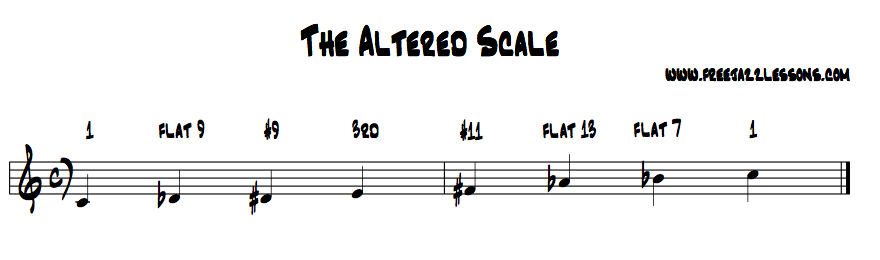
We can alter these extensions of the chord we just mentioned as well by playing b9’s, #9’s, #11, and b13’s. This is how we get the altered scale.
We alter every extension of the chord. No natural extensions like 9, 11, and 13. Everything will be flatted or sharped!
The altered scale features 3 of the 4 chord tones of a dominant 7th chord (1, 3, and b7) plus all the extensions of the chord altered. So, the theory for the altered scale is 1, b9, 3rd, #9, #11, b13, and b7.
So, whenever you see a dominant V7 chord to I written within a chord progression you can play an altered scale over the dominant chord.
By altering these notes on a dominant chord it really increases the tension. As we demonstrated in the video above if you really learn how to smoothly resolve this scale into your I chord it can create some very beautiful sounds.
It’s also a very powerful concept when you learn how to use the altered notes inside your harmony. Many of the coolest sounding jazz chords and voicings come from the altered scale.
If you want to learn how to use it inside chords and songs then check out the intermediate and advanced arrangements inside the Premium Jazz Membership Course.
If you want to learn how to use it in your improvisation then I also encourage you to check out my jazz improvisation instructional program here.
Music is all about controlled tension and release. 🙂
More Scale And Chord Resources
If dominant chord extensions are brand new to you than I highly recommend you check out this dominant chord extensions starter lesson to get you up to speed. I also recommend you start learning how to use augmented chord arpeggios in your jazz improvisation method because they come from the altered scale.
If you would like more information on some other useful jazz scales than you should check out this major chord scale lesson, this minor chord scale lesson, or this dominant chord scale article.
******
– If you enjoyed this lesson please leave a comment below and share it with your friends!
Thank you as always for your support of jazz education. Happy practicing and make some amazing music!


very good lesson Steve. I really didnt know what altered scales were and this adds interest to my playing.
Rico
Great to hear. Yeah, it’s used all over jazz so you’ll have fun with it 🙂
Thanks for the lesson Steve. Really helpful. My head is in bits with all this jazz!
Chris
p.s. I think this is a good thing?
Hi Chris,
Yeah jazz is the merging of art and soul. It’s a very deep style of music. Take your time and have fun on the journey.
you are doing a great job.creating an atmosphere of learning for the upcoming jazz musicians.God bless you.
Thanks for your kind words dami. Atmosphere is my goal 🙂
GREAT stuff. My nerd brain can’t figure out why you listed the 3rd before the #9 in the description of the altered scale. Best!
The #9, which is also a b3, is listed as a #9 to emphasize that it’s an altered extension. Extensions are named based on how it normally functions in a harmony i.e. being an actual interval beyond the octave. This is why it’s labeled as a #9 rather than as a b3. I hope it helps.
I’m really exciting in reaing this lesson. thank you very much.
No problem Thinh. Have fun with this one!
The most exciting simple lessons of my life: You are a gift!!
Very nice of you to say Obioma!! Thanks for your nice comment.
Nice lesson thank you so much!
I admire what you do and look forward to each lesson….My question is this the same as the vii of melodic minor..
Great thanks Zahiir. Yes, you are correct it is based off the 7th scale degree of melodic minor
Fantastic no better feeling than beginning to recognize scales…Because of this article I will not sleep tonight and shed this puppy through ” ALL OF ME “… Thanx again
Steve..the world needs more people like you…gifted, generous and giving..Thanks so much for the lessons!!
Wow that’s really cool of you to say that Brian. I really appreciate you’re nice words!
I love playing the altered scale C when playing in the key of F…So cool running up with the scale to Gb9 Left hand resolving to F…Thanks so much for sharing your gifted talent…You are truly a selfless person with your rich music…Jim
It’s a great sound isn’t it Jim? It’s my pleasure to teach and hope you’re really learning a lot here!
Great lesson! Do you have any pointers on actually memorizing the altered scale in all 12 keys? (And do you offer private lessons?)
Hi Bill,
Thanks! First, you should know all your major scales in all 12 keys. From there you can just start working out your altered scales in relation to the major scales. Use the concept 1, b2, b3, 3, #4, b6, b7 if it’s easier for you.
Yes, I do give private lessons as well 🙂
think first four notes of a half/whole diminished scale, the rest is whole tone to the tonic.
Hey Steve, In this lesson you say the flat 9 pulls down to the 5th in the altered scale? How is this so when you hit C as a pull down note? Do you mean the 1st? I guess I’m not understanding your pull down notes. Thanks
Great lesson Nixon, I suppose that’s a 5-1 on key F
Yep
AWESOME LESSON ON THE ALTERED SCALE STEVE…ive been studying piano and jazz piano for a very long time…and my teacher NEVER told me about this SCALE..
THANK YOU SO MUCH BRO…love your site!
paul barrett
south jersey
USA
Thanks a lot Paul. It’s a very popular scale that’s used all the time.
Steve–you mention that the altered scale contains all the chord tones of a dominant 7 scale including the 5th, however I don’t see the 5th in the scale illustration. Maybe I’m missing something here
The note you give remind me of a Dd scale, but the way you explained it opened up a world of possibility, thanks for the mind opening lesson.
You’re the man. Its really been an eye opener. Its not just useful in jazz alone but even in black gospels. Thanks
Thanks my friend! Yeah it’s a very versatile sound in many styles.
great lesson!
Cool. Thanks and glad you enjoyed it.
Sorry the spell check keeps messing up my comments I meant the altered scale is the 7th mode of the melodic minor scale.
Yes you are correct Ian! Great point and thanks for mentioning that.
Hi Steve,
Many thanks again for a great lesson. One question.
You write:
“So, whenever you see a dominant V7 chord to I written within a chord progression you can play an altered scale over the dominant chord.”
Do you mean “over the ALTERED dominant chord”? The left hand chord you used in the demo seems to be an altered C7. But unaltered seems to work a well, although
with more tension. Can you comment?
Thanks!
Bob
Yes, over the altered dominant chord.
Hey Tom,
There are several different ways to finger them and each key is a bit different. You could definitely use melodic minor as your guide though and start on the last finger you would use on the 7th scale degree of your melodic minor. Hope that helps!
Hey Derrick,
Start exploring the jazz scales lessons, chord progression lessons, and the lick lessons on this site. There is a search bar on the top of the site. This should help you start organizing a lot of the information and definitely start answering your questions.
I learned this scale 40 years ago. We called it a diminished whole tone scale. Taken from the diminished scale 1/2step whole step
Steve, I buy lessons from you and have been a member of freejazzlessonns.com, but rarely comment because I don’t have the needed password. Now I just found the post ad a guest!!!! I’m an old man. If you can enlighten me I’m always willing to learn?
Hey Bruce!
Thanks for the comment. Looks like you figured out a great shortcut for the comments section. I always recommend people post as a guest and then just add their name. It’s easy that way. That’s awesome. We appreciate the support over the years and love to share music with you.
Hi Steve
A very clear and understandable explication of the possibilities of overtones structures. Very very helpful to me. THANK YOU. Rolf.
Great to hear Rolf and thank you!
Hi Steve, As you know, I’m a big fan, so I just wanted to share a thought with you. I noticed that the altered scale is the melodic minor of the letter name a half step above. eg. C altered would be Db (C#) melodic minor. Another thing I noticed was the second tetrachord of this scale is a whole tone scale. Keep up the excellent work.
Bam Fred! Great observation. Lots of people think of the altered scale that way because it’s also a mode of the melodic minor. Thanks for your comment as well and your kind words 🙂
My theoretical confusion lies in the fact that you describe the chord as one in which only the extensions (9, 11, 13) are altered. But isn’t that somewhat contradictory, in that, for example, the 2 is also altered, as it is the same note in the scale as the 9? Same for the #11, which is also a #4, and the flat 13, which is the same as a flat 6. By saying that only the extensions are altered, doesn’t that imply that the 2, 4 and 6 are not altered? Yet obviously they are. Why not just call a spade a spade, and describe an altered chord as, for example, a c7 (b2, #2, #4 and b13)?
Pitch-wise, yes you are correct in saying the 9, 11, and 13 are the same as a 2, 4, and 6. However, as intervals they are not and they sound a bit different, given that extensions are at a higher register relative to the root. Jazz harmony emphasizes this fact and so your extensions are named that way.