
Free Block Chord Piano Lesson

April 21, 2026
Do you want to learn more about block chords? Are you looking for an easy jazz piano lesson on the locked hand chord style? You’ve come to the right place!
In today’s lesson we’re going to take a look at a style of block chords made famous by George Shearing and Ahmad Jamal (video tutorial, notation, and tips below).
Block Chord Tutorial Guest Teacher
 So, a few nights ago I was at my friend Pete Benson’s gig at Andy’s Jazz Club in Chicago.
Pete was playing all kinds of cool stuff that night but one thing I particularly liked was the way he would break into locked hand style every once in a while.
The whole time I was thinking, a) “Man, Pete sounds great playing this style!” and b) I should get Pete in to teach a lesson on block chords to the community here on FJL.
So, I convinced Pete to come in to the studio. He was kind enough to come in and film a couple short block chords tutorials.
Block Chord Video Tutorial
Why don’t you take 2 minutes and watch as Pete shows you how to play block chords inside a II-V-I chord progression. Then, scroll down for the notation and important extra tips.
5 Tips To Help You Learn Block Chord Basics
Here are some important tips that will help you master the basic concepts behind the locked hand chord style.
1. Double The Melody
The first step of getting these block chords under your hand is to double the melody an octave apart.
You do this by having the right hand play the melody on top of your voicing. Then, you have the left hand doubles the melody not an octave below.
2. Fill In The Chord Tones
Once you have the melody in octaves you simply fill in the rest of the chord tones in your right hand.
3. Every Note Is Harmonized
There are lots of different arrangement techniques you can use to harmonize jazz tunes. For example, here are a just a few types:
- Drop 2 voicings
- Red Garland voicings (which we discover in The Jazz Masters Method program and the Georgia on My Mind tutorial inside the Premium Membership Course)
- Quartal Voicings
- Spread Voicings (which we explore in depth inside the chords library of Premium Membership)
- So What Voicings
- Cluster voicings
- Rootless voicings
- Left hand walking bass + right hand melody and chord voicings (you can learn more about this inside the “There Is No Greater Love tutorial”
- Locked hand style voicings
- & many more
One of the things that’s distinctive to the locked hand style though is that every single melody note is harmonized with a new chord voicing.
It makes each melody note sound very rich and thick.
4. You Can Mix Locked Hand Chords In With Other Voicings
People like George Shearing would sometimes play a whole tune or a whole chorus of a solo just using block chords.
Then there are other artists who will mix in block chord voicings in with other chord techniques as well. Both methods are very cool but they of course create different sounds or textures.
Pete actually mixed his voicings up in the video above. He played the first 2 piano voicings in the locked hand style and then the 3rd one in more of an open style.
It creates a nice feeling of tension and release. So, I encourage you to mix and match these voicings into your playing.
5. Why We Study II-V-I Chord Progressions
The chord progression from this lesson is the II-V-I. It’s the most popular jazz chord progression and can literally be found in hundreds of tunes.
So, as long as you have a basic concept of how to transpose you can apply the chords from today’s lesson into tons of tunes.
Need a list of tunes to learn? Check out this lesson on essential jazz standards to learn and also this lesson to learn jazz standards.
Notation For These Chords
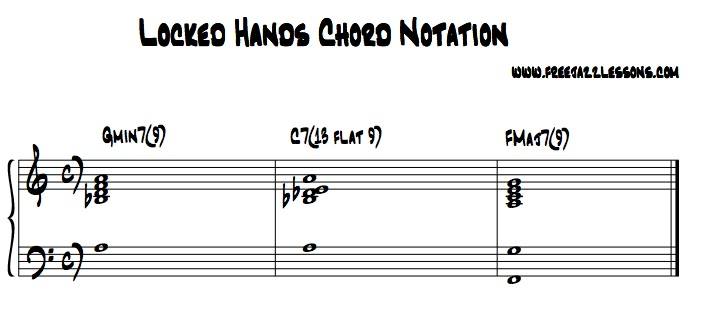
Please Welcome Pete!
Do you have a question about this lesson? Did you enjoy today’s lesson? Please leave a comment below and let us know.
I’d like to thank Pete Benson for taking time out of his busy schedule to come in and share music with us! Thanks Pete!
Also, since this is Pete’s first lesson on this site please make him feel welcome! Leave a comment below and welcome him to our community.
(By the way, Pete will also be showing you how to apply locked hand voicings inside an actual tune in a future tutorial. Make sure you watch for the lesson. It’s coming soon.)


This is a great idea,Steve, and thank you, Pete! I’ll look forward to more about locked hand voicings.
Thanks for the lesson Pete. I am looking forward to future locked hand lessons. The locked hand method that I was taught many years ago at a seminar by – you got it – George Shearing and also at a one on one at the Plugged Nickle in Chicago with Jimmy Smith literally had me lock my hand in a fixed position and play. C major 7th (cegb) becomes, as you move it up the C scale, Dm7 – Em7- Fmaj7 etc. or Cmaj7 no root in right hand (egbd) up one full step becomes Dm9 (face) etc. I’m sure I am explaining this technique poorly but it sounded great when they used it and gave me a different way to approach a song. Please write more soon as I can definitely use a refresher on this method.
Hey Pete,
Welcome to the club!! Your tips on the block chords are another quiver in our bag of tricks. Enjoyed your simple & direct explanation. Looking forward to more tips from you.
Dick Bennett
Cool lesson. Just a heads up: in the video, during the second chord, the overlay says B while Pete is playing a B ♭.
Good tip. We’ll have to adjust that. Thanks!
Welcome Pete!
Hi Ray,
Thanks for your comment. You can play other notes in the left hand besides the root in the locked hand style. This is also true for several different voicing types. In the locked hand style you’ll double the right hand melody note in your left hand.
So, if you have an A as your melody (which is the 9 of Gmin7) then you’ll also play it in the left hand.
Great lesson. Maybe later we could get the whole song in this style.
Rico
Steve, I’ve been following you now for a couple years and I find your lessons very helpful. I have bought a few items and getting ready to get a few more. Keep up the good work and welcome to Pete. I was just in Chicago for a few days, it would have been nice to see some jazz groups but I did not have the time. P.S. I took a correspondence course from Berklee in 1971. Just mentioned that as I know you are a Berklee alum.
Hi Fred,
Thanks for your comment and your purchases over the years. It’s been a pleasure to share music with you. Chicago has jazz 365 days a year so next time you definitely got to catch a show! That’s cool that you took some correspondence from Berklee. They definitely don’t offer that now so that’s pretty neat that you could do that back then.
Thanks again for the comment Fred.