
3 Of The Most Useful Scales To Play Over Major Chords

April 2, 2024
 When most players first start jamming over major chords they’ll usually turn to licks and ideas built from the major scale.
This can create a nice inside sound but often times the lines can get predictable and somewhat boring.
We don’t want to be boring and predictable right? 🙂
Fortunately, there is a solution to spice up your soloing over major chords. So, in today’s free jazz lesson we’re going to explore a couple other scales (modes) you can use over major chords. In case you missed it, here’s our comprehensive guide to exploring jazz piano scales.
These scales will provide some additional note choices that will ultimately give you more ability to express yourself (video, lesson, jam track, and notation below)
Bonus: Here is a free jam track that you can use to practice these different type of major scales/modes over. The track features real samples of upright bass, drums, and percussion.
It is over 4 minutes and gives you lots of time to stretch out, learn, and jam. Enjoy!
The Piano Scales Notated
Here is the first scale you can play over major chords. I’ve written them as key of C scales but you can and should tranpose this scale to any key that you see a major chord in.
If you need more ideas about how to creatively practice scales and technique make sure you also check out this jazz technique article
(Also watch the video above to really learn how to jam with these different scales)
1. Major Scale
(Scale Degrees 1, 2, 3, 4, 5, 6, 7)
 This is the most fundamental and basic of all the popular scales. You’ll see a lot of jazz theory books say the 4th scale degree of a major scale is considered an avoid note in this scale.
This isn’t always true though as there many examples of jazz musicians playing the 4th scale degree over a major chord.
For example, this turnaround lick features this concept and so does this Charlie Parker lick .
I think the thing to keep in mind is that you don’t necessarily want to sit on the note. It needs to be resolved.
Now, that we’ve gone over the basic scale are you ready for something a bit more interesting sounding now?
———————————————–
2. Lydian Scale
(Scale Degrees 1, 2, 3, #4, 5, 6, 7)
I love the lydian mode. In my opinion the #4 is one of the most beautiful notes you can play over a major chord. So, I’m partial to this scale.
It should be noted though that most of the time people will eventually resolve the #4 up to the 5th scale degree since it’s a chord tone and more of an “inside” note.
———————————————–
3.Mixolydian Scale
(Scale Degrees 1, 2, 3, 4, 5, 6, b7)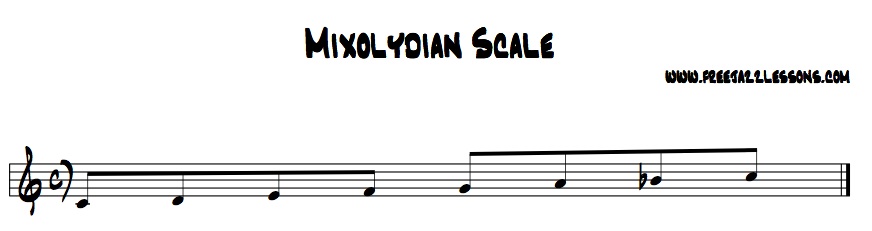
Technically speaking this is a dominant chord scale but you can still sometimes hear this scale being played over a major chord.
It creates a bit more of a blues like sound. If you’re interested in other dominant chord scales also check out this dominant chord scale article.
Piano Scales Practice Tips
1. Remember to learn these scales in all 12 keys. You want to sound just as good in the key of Gb as you do in Ab.
Fluency in all 12 keys is a must and it’s fun to explore your instrument on a deeper level.
2. Try learning some scale sequences and patterns to apply to these popular scales. Sequences are a melodic patterns repeated but started on different pitches.
Put on the jam track above and start applying some sequences of these 3 major modes on top.
Update: There is a now a lesson on minor jazz scales too.
**********
I hope that you’ve enjoyed this free jazz lesson. These are very popular scales and can be used in so many different songs and styles of music.
Feel free to come back to this page regularly and practice using the jam track above.
If you are new here are please be sure to say hello and leave a comment below.
Also, be sure to sign up for the free jazz lessons email list. It’s quick, easy, and free. The sign up form is on the right side of the website.


Hi, Steve!When we are practicing scales, we can create different combinations of intervals and triads, and then use it as a “fill” in improvisation (between a licks for example).But if we play only eighth notes it sounds like a pattern. Must be divide using the pause. How to learn to set pauses?
There are lots of ways of handling this. Here is one idea. You can practice using a lick or idea but adding rests within the lick. So, you could take out certain notes w/ in the phrase and just replace them with rests. The phrasing of the lick still remains intact but the lick sounds different because of the added rests.
I got it!”Swallowing” the some notes do not destroy the logical construction of the pattern or lick and producing unexpected phrasing for the audience and rhythm group.This is the real way to turn dry exercises into live music! And this is one way from the few?Steve! Respect and appreciation! Thank you!
Excellent jazz lessons
@Ivo. Thanks! Glad you’re enjoying the material and the community.
Thanks Steve for these free lessons and site. I hope it will last and you will keep it as simple and informative. It’s nice to hear the stuff and be able to play along right away! By the way is there any means to download the jam tracks to paste them in “transcribe” for example in order to change the tone, pitch…
thanks, nicolas.
No problem Nicolas. Glad you’re having fun here 🙂 I will actually do a few lessons in the near future where I talk more about more ways of creative ways of using these jam tracks. I’ll feature some other programs as well.
Excellent, I just discovered this website and this will help me a lot to get more into jazz, thanks for doing this
@Oscar. Welcome to the community! Happy to have you.
Steve..can you post the ascending chords to a dim. 6th scale?
thanks a lot its great help for me to learn jazz music
My pleasure Ruben. Enjoy!
Hi Steve, I played awhile as a self taught musician before majoring in music theory many years ago. I always wanted to use theory in my playing but the concepts were too muddy for me to be useful. Your videos and teaching methods are incredible – thanks for all you do for us!
So cool of you to say Dell. Thank you and glad you’re enjoying the lessons. Welcome to the community!
Hello Mr Steve,I learnt the piano/keyboard through tonic sol-fa notes and also ear trained to grasp any note.I can improvise a lot and i have been able to drastically improve my skills to play on a lot of styles(rock,pop,jazz chords,classical,basso,etc)My challenge now is sight reading/playing which i have been trying to get a quick technicality on.I can read the beat/notes on the stave but still takes a lot for me to read and play at the same time;especially that i am already used to playing looking at the keys or used to the keys.I just fill like i am going through hell now especially when it feels like i am trying to learn piano all over again.Can you help me out with anything you can?And i also have a great paying piano job coming but the major requirement/criteria?SIGHT READING! please show some help tools.I,ve got liitle time.Ebiye Prosper
Just came upon your website and I’m addicted. Misty reharm is great, also tritone substitution tutorial clear and precise. Thank you. Richard
Awesome Richard. Love to hear you’re enjoying it. Lots more stuff to come your way Richard. Welcome to the community and glad you are here!
Being a rather mediocre guitar player I am excited to have stumbled upon this page. It gives me so much input that everyday after work I can hardly wait to pick up my instrument and play. I’ve been playing music for over thirteen years, I also worked my way through some books on jazz, but finally I have the feeling that I UNDERSTAND!
Many, many thanks!
Awesome to hear. Glad you find it inspiring and useful!
Quick Question? – Just subscribed – seems like an awesome learning site
Question is or maybe a request
I do realise that a good starting point for me would be to practise all scales major, minor, blues , dorian, phyrigian etc etc
Do you have a pdf with all scales and all keys (with fingering) as that will be my first attack I would think?
Thanks Mark! I actually include an Ultimate Jazz Scales Book as one of the bonuses for my Premium Jazz Lessons Membership Course.
Thanks Steve, Just wondering is the Ultimate Jazz Scales Book in the DVD that is being posted to me or online as I can’t seem to find it online
Cheers
Andrew
Hi Andrew, The Ultimate Jazz Scales Book is available as a bonus for Premium Membership yearly subscribers freejazzlessons.wpsc.dev/premium
Is it correct to say, in this given example of a Mixolydian scale (C), that this is the 5th degree of F major?
Yep! Good question.
Hi, if the chord progression is ii-v-i in key of C major, then what scale should I use?
D dorian scale-G mixolydian scale-C major scale?
or C dorian scale-C mixolydian scale-C major scale?
Thanks
Hi Kao,
In this particular instance you could use D dorian scale-G mixolydian scale-C major scale. Thanks!
Wow thanks Steve
You are welcome Herbert.
hi do you have any books online e.g. fundamentals of jazz/ how to play jazz?? thanks
Hi John,
We have something even better than that. We have a whole video course and lots of sheet music on jazz fundamentals. It’s called the Premium Jazz Lessons Membership Program. You can check it out right here freejazzlessons.wpsc.dev/premium.
(I also include lots of bonus books and resources in the course in addition to the videos.) Look forward to sharing music with you further!
Hey Steve, I need your advice. I have always use tricks to simplify maneuvers for example: To target notes for chords or tenths, I concentrate on the little finger on the left hand and let muscle memory to a large degree do the rest. I noticed that Lydian scale is using the G scale and the Mixolydian scale is the F scale. Question: Is it advisable to think of the scale on the 4th and 5th notes of the existing key or is this crippling. Thanks, Bill.
Hi Bill,
I would think of it as an entity in itself. I would not refer to another scale. When you think of it as really a different scale it can work but it often times puts an additional unnecessary step in the brain processing and can effect your note resolutions.
What is the left hand comping? Looked like E – A – D,
sometimes E-G-A-D (I think) — I guess it’s a C 6/9 with no root?
Hi Franklin,
In the context of the key of C, that is correct. E – A – D is a rootless C6/9.