
Summertime Backing Tracks and Free Chord Chart

March 24, 2026
Would you like jam on a Summertime backing track? Well, you’ve come to the right place!
One of the main goals of this site is to consistently teach you how to improvise jazz on a higher level.
(Summertime backing track, chord chart, and extra tips below. :))
Prefer a PDF version of this lesson and chord chart? Get a FREE Download here:
Learning jazz licks and jazz piano chords is super important but we should always keep in mind that any chords or licks we learn are just individual pieces of the jazz ‘language’.
In order to best learn this language of jazz improvisation though we need to apply our licks and chords to songs and real pieces of music!
So, to help you practice your jazz improvisation I created a free backing track for the famous jazz standard Summertime.
I even included a lead sheet/chort chart so you can play the melody and the chords too! 🙂
Now I love playing solo jazz piano as much as anybody but there is just something really fun about playing with with a rhythm section accompaniment (either live or a backing track).
Having bass and drums behind us can free us up creatively and even rhythmically. Plus, it just feels good too!
Summertime Chord Chart
Here’s the chord chart and lead sheet to Summertime.It’s in the Key of D minor. You can download a pdf or click on the chart to open it in a new window. (Play Along tracks below.)
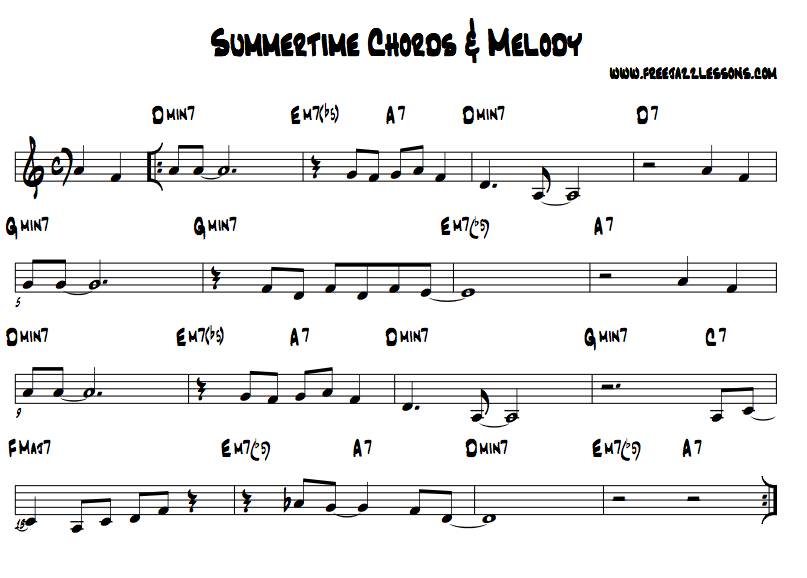
Download Summertime chord chart pdf
Feel free to share this chart. The only thing I ask is that you credit freejazzlessons.com or provide a link back to the site. 🙂
If you need some chords to play on this tune you can check out this lesson on minor 7 flat 5 piano chords and this lesson on minor jazz piano chords.
The Herbie Hancock licks and chords, the Diana Krall licks and chords, and the Chick Corea licks and chords you learn my Jazz Masters Method Program will work great over this jam track as well.
Summertime Backing Track
Here’s the jam tracks for Summertime. It features a swinging drum and bass accompaniment. There are actually 2 different version with 2 different tempos.
One of them is a nice and easy 100 beats per minute and the other one is 120 beats per minute. You can start out with the slower tempo and work your way up to the fast tempo if you like.
The jam track at 100bpm
The jam track at 120bpm
So, turn your speakers up, grab your axe, and start practicing with the play along below. Enjoy!
If you prefer to jam on Youtube here’s a Youtube video jam track I just made of Summertime too 🙂
Additional Jazz Arranging Tip For Jazz Beginners
Here’s a couple suggestions for form and arrangements when playing jazz tunes. You can apply these below or do your own arrangement on Summertime.
- Usually when you play a jazz tune the head or melody of the song is played first.
- Then you improvise over the chord changes and the form of the song many times over.
- One time through the form of the song is called a chorus.
- Once you’re done jamming on the tune and finish a chorus you play the melody of the tune again.
- Often times after that there will be some sort of small outro and then the song is done!
- Take a listen to how these masters play the form in this list of jazz standards to learn.
*****
Did you enjoy this Summertime backing track? Please leave a comment below. Feel free to come back as often as you like to practice Summertime too!
If you’re new here remember to also subscribe to the freejazzlessons.com email list.
- You’ll receive free lessons right in your inbox regularly.
- You’ll also be joining one the fastest growing jazz education communities on the internet.
- You can subscribe using any of the email forms on the sidebar.


Thank you Steve for both the chart and the track. This is one of the first songs I ever learned. Time to relearn!
absolutely my pleasure. Have fun with it!
Great, Steve. Thanks.for this nice support.
WOW !
Thank you very much !
Jack
Canada
Thank you, Steve. That was fun.
You’re truly welcome Holly. I’m glad you had fun!
thats awesome Steve! 🙂 thanks
Thank you VERY MUCH, Steve. Love it and look forward to more.
You are a very special person in my world. Once again Steve, thanks soooooo much!!
Thank you Deane!!
I guess I can’t really use the awesome backing track. 🙁 I keep feeling like I want to play around with with the melody of Em7(b5) and A7 and also the melody of measure 7 (Gm7). I feel like I want to extend those both out another 2 whole measure. for…..example…..
|G F-G G F-G | G F-G A-G- F | D
(notes that stand alone are 1/4 notes and notes with (-) are 1/8th notes D=whole note)
This way you sorta “stutter” on these notes and really swing. The backing track however, does a chord change in the 3rd measure to Dmin7.
Is this how you have the backing track set up Steve?
thanks
Hey Curtis. Feel free to play around with the melody in terms of your own personal phrasing. The chords of the tune are set up exactly like the chord chart in the article.
Hey Steve,
Me again. 🙂 I have a couple questions for you. I sense the main objective here is for us to learn to build our own licks or lines by analyzing the licks that you create. Not just copy lines that you create and put them in standards. So I do practice your lines but tend to put that aside so that I create my own material and that helps to get my brain working a little harder. My problem is, I guess since i’m still fairly a rookie at all this, my confidence level in what I create is low. It sounds good in my head and even when I play it but I’m always feeling like maybe it’s not good enough. You have been playing for allot of years. How long did it take you to get that feeling of confidence in your playing?
My other question is now that I have a good “A section” down for Summertime and good “2nd A section” , I’m working on building a Chorus now. I basically start my lick with and arpeggio down from D(triplet) and back up with swing eigth notes and and passing tones and then back down again with passing tones to get to the Bb of the Em7b5. but what I’m doing is, I’m hitting the Bb as a grace note up to B natural (3 times). Are grace notes considered….quarter notes? I know how to count everything else. I just never knew how to count grace notes. 🙂 Thanks
Blown away by you’re marvelous free gifts. I will be buying your stuff soon (when I’ve saved up enough), but thanks for all the great sounds made simple to execute by your great teaching methods. I learned heaps. Went to the JA seminar once in 2003 learned so much more since then from you. Thanks matey much much appreciated.
Thanks Geoff. Glad I’ve been able to help you grow further since your Jamey Aebersold camp. Great to hear! Look forward to sharing music with you through the Jazz Masters Method. Thanks.
Hello! Love the track 😀 Can I purchase it? I play for retirement facilities and they would dig your arrangement 😀
Hi Jen,
This track and many others are included as part of this program right here freejazzlessons.wpsc.dev/premium
Thanks!