
Wynton Kelly Jazz Lick Lesson and Video

April 21, 2026
 One of the best ways to learn how to improvise in jazz music is to study the licks and improvisation of the jazz masters.
So, today we’re going to check out a super fun Wynton Kelly jazz piano lick.
This particular lick has some fantastic source material in there to really get your jazz language happening.
Enjoy this free jazz piano lesson and get started learning this lick now!
(Remember to scroll down and watch the video demonstration, notation. Also, check out the extra tips below)
4 Thing to Learn From This Jazz Piano Lick
1. You can mix and match your minor scales.
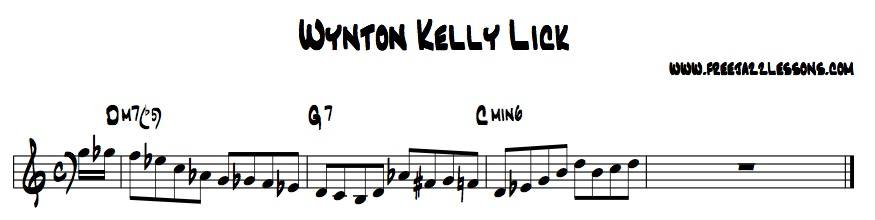
This lick is in a minor key. In just these 3 measures here Wynton plays a natural minor scale idea in bar 1, a harmonic minor scale idea in bar 2, and a melodic minor scale idea in bar 3.
How To Practice: Try mixing and matching natural minor, harmonic minor, and melodic minor scales over minor 2-5-1 jazz piano riffs.
2. You can superimpose chords on top of chords.
For the most part Wynton is actually playing an Fminor arpeggio w/ some chromatic approach patterns over bar 1 Dmin7(b5).
How To Practice: Try soloing over a minor 7(b5) using a minor chord arpeggio a minor 3rd up. So, as an example if you have a Cmin7(b5) you can solo using Eb minor arpeggios.
If you want to see another approach to playing over a minor 7(b5) chord then check out this Red Garland lick lesson or this other minor jazz lick lesson.
3. Shape is important.
Wynton does an excellent job of going down w/ chord tones and then connecting them into other chord tone notes w/ scales.
You’ll see this alot in many bebop licks. Arpeggio (either up or down) that then connects into a scale idea and goes the opposite direction.
How To Practice: Construct some licks that use this bebop shape by playing ascending chord tones for the first 2 beats of a chord and then for the next 2 beats descend into a scale motion.
If you want to check out another lick that features this awesome concept then be sure to also check out this Charlie Parker Lick
4. Approach Patterns are our friends.
Wynton Kelly does an excellent job of throwing in really beautiful sounding chromatic notes.
He does this by mostly using approach patterns. We’ve discussed approach patterns before here and in the All The Things You Are Lesson.
As a reminder though, approach patterns are 1-3 chromatic notes that are played either above or below a chord tone. They are played in order to lead into chords better and often times are used to extend a jazz lick or delay resolution.
On a simple level chromaticism is also a HUGE part of the jazz vocabulary and it just sounds great.
How To Practice: Practice leading into chord tones on downbeats by playing a couple chromatic notes either above or below your note choice.
Need an example? Wynton Kelly does this in every measure but a simple example of this is the pick up into bar 1 beat. He is resolving into F (over the Dmin7(b5) chord) but plays two chromatic lead in notes before hand…G and F#.
I hope you’ve enjoyed this Wynton Kelly lick and free jazz piano lesson. If you enjoyed learning this lick then you’ll really love my Jazz Masters Method Program.
There is a whole section on there on Wynton Kelly and 8 other legendary jazz piano players.
———————
If you are new here are please be sure to say hello and leave a comment below. Let me know how these jazz concepts are working out for you!
Also be sure to subscribe to the free jazz lessons email list.


Steve,
Great lesson! Even though its the first lesson Ive gone through, I love how you break down the theory and add many ideas for improvisation. Looking forward to all the other lessons.
Thank you very much. Awesome that you enjoyed the lesson and welcome to the community here!
fantistic licks Steve keep em s coming.
Cool thanks Joe! I love Wynton so glad you dig it too!
thanks to you I got started with playing the piano. Thank you!
Great to hear. Have fun Marta and thank you!
I’m finding these lessons really helpful, thanks to the clear presentation and practice guides. I’ve been struggling for years to improvise using chord symbols but these lessons show how to build up sounds and develop ideas from shapes not just numbers, and explains why and how it works when it sounds good. Thank you!
Awesome to hear Jane and very happy to have you here!
Great lesson Steve. The practice sessions are loaded with explosive improvisational ideas and can elevate one’s improve. This lesson is a job well done and what an arsenal if one follows the practice sessions to heart.
Thanks George!
Thanks Steve, for shedding light on the Mysteries of playing jazz piano!
`
My pleasure Clive!
Steve – I am LOVING your lessons. My dad was a borscht belt sax player and general wind guy (he’s 89; I’m 58), but I have never been able to really understand jazz beyond the basics of playing major or minor scales with the occasional flat 5 or 9 (even with his explanations) over the melody, triads, or left handed octaves. Until now! You’ve opened up a whole new world. Your free lessons are all I can handle right now, But I am requesting my kids get me the Masters DVD’s for Fathers Day. And eventually I hope to move up to Premium lessons. Thanks SO much!
Dave
Thanks David for your very kind words. I appreciate it and look forward to sharing music with you further through our courses!
That’s great to hear David! Enjoy the Jazz Masters DVD and I can’t wait to hear about your progress.