
Learn These Great Jazz Piano Voicings (Free Sheet Music And Video)

September 3, 2026
In today’s tutorial we’re going to explore some great sounding dominant jazz piano voicings.
Many beginner jazz piano players will play the same chord voicing every time they see a dominant chord in a lead sheet or a fake book.
This isn’t horrible per say but if you keep playing the same voicing over and over your playing can get boring very quick.
You don’t want to bore your audience right?
So, having a variety of chord voicing choices is critical if you want to keep your music sounding fresh and interesting.
To get you learning these chords quickly first watch the video below and then scroll down for the jazz piano sheet music (notation) and important extra tips.
Jazz Piano Voicings Video Tutorial
Remember, listening is a HUGE part of learning jazz piano the right way. So, I highly encourage you to watch the video!
You can’t play this style well just from reading easy jazz piano sheet music alone. You’ve got to use your ears too! 🙂
3 Additional Tips That Will Help You Master This Jazz Piano Tutorial Tutorial
1. Adding 1 or 2 color notes or an extensions on your dominant chords are a great way of making your voicings sound more professional.
(We’ve talked about this before in some of my other jazz piano theory lessons and in my lesson on the altered scale.
Of course we throw it all together and into real music inside the Premium Membership Course.)
2. Usually the root, the 3rd, the 5th, and the 7th of a chord are considered your basic chord tones. Extensions of a chord are your 9’s, 11’s, 13’s etc.
3. Did you notice how cool it sounded when I changed just a few of the notes inside the chords by a half step? That’s the power of great harmony!
For example, check out the subtle difference between voicing #1 and voicing #2 and voicing #3.
Jazz Piano Sheet Music
Here is the jazz piano sheet music (notation) for the voicings in today’s lesson. I encourage you to try out these chords on your keyboard at home.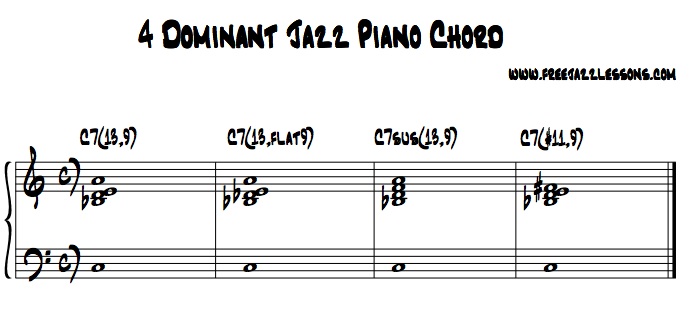 Listen to the different textures and how just changing a few notes completely changes the emotional ‘color’ of each chord.
How To Practice These Voicings
I encourage to sit down for a few minutes and try out the different voicings in the video above. Here are some practice suggestions that will help you.
1. Study In 1 Key First
First, try them in the key of C and listen to the different textures.
2. Jazz Piano Theory Helps Multiple Keys
I always break down the jazz piano theory in all my videos so once you play these voicings in the key of C you should try them out in a few different keys.
 3. The Goal Of All 12
If you are a diligent practicer (like I am and I hope you are too!) I encourage you to eventually work them out in all 12 keys.
As jazz musicians we usually like to set a goal of learning a new concept in all 12 keys.
This can sometimes feel intimidating for jazz newbies though so feel free to take your time and slowly work through the process.
One key learned well is better than 12 keys learned inefficiently. Regardless of what you decide to do try to challenge yourself.
Being able to create these little sound variations in multiple keys is an integral part of being able to express yourself through the art form of jazz!
4. Ultimate Goal: Tunes!
As my Premium Members can attest to, I always have my students apply new voicings they learn to tunes. That’s the ultimate goal for any new jazz piano voicing you learn. Apply it to real music!
By throwing your new voicings into real pieces of music you’re taking it from the land of music theory to the land of real music!
You are here because you want to make real music right? 🙂
Important Final Step
Ok, so now’s the part where you get participate in today’s tutorial.
- Do you have a favorite voicing from the 4 voicings in the video?
- Do you have a tune that you’d like to throw these voicings in?
- Do you have questions on any of these chords?
- Do you think I should wear a fedora in my next video?
- Do you think I should do a dance routine in my next video (I’m praying you say no. I’m a horrible dancer)?
- Do you think I should have my cat Apple make a cameo appearance in my next video?
Speak your mind! Please leave a comment below and let me know.
Leaving a comment not only helps you learn but it also helps other people learn too. Plus, I love hearing from you!


I listen to music and hear these great chords, and wonder, “How do they do that?” Then up pops Steve and shows me. Thank you very much for your work, and sharing.
My pleasure David. Glad I could unlock some of those chord mysteries 🙂
You’re Amazing, thanks for your support to all musicians
Thanks Edmond!
All of these voicings start on the b7. Would you voice them the same way starting on the 3,4or #11? I am thinking of using these chords in the LH to accompany a RH solo.
(3,13,b7,9); (3,13,b7,b9);(4,13,b7,9) and (#11,13,b7,9). I use the first two but the last two seem odd with the 4 or #11 in the root of the LH.
Theoretically you could but it would depend on how low or high you were on the keyboard. Register on the piano plays a huge role in voicing decisions.
Steve God bless u soo much 4 the wonderful thing u r doin for we musicians. We really appreciate you nd for me personally, am in Ghana Ba I look forward to meeting u oneday and I pray it comes soon. U really inspire me
Thanks Godfred!
I feel like a complete beginner but what makes these chords “dominant” ? I understand voicings and how we can rearrange the order of a chord to get a completely new sound or keep the melody note on the top of the chord but you lost me with the term “dominant” :)) Thanks!
Hi Dakota,
Dominant refers to a chord having a major 3rd and a flat 7th. So, for example in C the notes would be C-E-G-Bb.
A major 7th chord would have a major 3rd and major 7th. The notes for that in the key of C would be C-E-G-B. It’s just a half step difference on the 7th for those 2 chords but the sound is completely different!
Steve, even though I’ve studied classical for many years–actually, I’m beginning to realize I never really studied–what I did was learn how to play pieces. It’s not the same thing as what we’re trying to do in jazz. So, I too am a beginner and certain terms are Greek to me. For example, what’s a lick and what’s a transcription? Add my name to the long list of musicians who say THANK YOU THANK YOU THANK YOU. By the way, it would be fun to see Apple in a cameo appearance. I think that’s your cat’s name. Nancy
Hi Nancy,
Thanks for the very nice words and happy to help. I think many musicians have felt similarly to you. Often times in classical, a player will learn a piece but never really gets into the theory or the construction of the piece. This can create a challenge. When someone studies a piece of music or a jazz tune it provides an opportunity to learn more about music as a whole. One has to really dig into the piece though and not just read the notes on the page. Personally, I’m not a fan of only learning things on the surface. I’ve always tried to go super deep into understanding the real building blocks of what makes a piece work. Studying jazz for all these years has actually helped me become a better classical musician.
Thanks Steve, for the voicing lesson it open up a new direction musicaly for me.
You’re welcome Winston. Happy to hear that it opened up a new direction. That’s what we’re trying to do here 🙂
Very useful chords. I am applying them to Gershwin’s “I’ve got a crush on you”
Fantastic. That’s a good tune to play them with.
Am practising them tomorrow morning, #soo excited. Thanks Steve
You are welcome. Let us know how it goes for you.
ah…..Im so happy to play these nice hearing chords…..#sooooo excited!!!! 🙂
Awesome Malosi. Enjoy your practice. They’re fun voicings to experiment with.
Hi Steve!
first of all, thanks for this lesson! I am applying these new voicings on “Waltz for Debby” by Bill Evans and it works!
However, I don’t know which scales to use on the C7 (13, b9) when improvising. Can you tell me one?
Thanks! 🙂
Elena
Hi Elena. It’s my pleasure. Thanks for posting a comment! For C7 (b13) You can use the altered scale as one of your scale choices. For C7(13, b9) you can use the half whole diminished scale.
Thanks! 😀
wow awesome stuff
Thank you!
Hi Steve.
First of all thank you so much for your very valuable and appreciated teachings.
I’ve been in music all my life and only in the past year or so have learned to love jazz. I’m a piano Accordion player and self taught on piano buit as you can imagine my left hand is useless to say the least, can you please suggest some way of loosening the LH? it is really frustrating since it makes me (basically ) a 1 hand piano player :-(. many thank.
Nibs
Thanks! I would try playing some scales and doing some exercises (i.e Hanon exercises, Czerny, Pischna, etc). in your left hand. This can help you increase your endurance and strength.
Thank you so much for your prompt reply Steve, Much appreciated .
Hi Steve, Like others I’m classically trained and so understand the chords but never used them.. It’s a long way from triad and inversions but I get it. It seems to me though that introducing sus and 9 and 13 and perhaps a raised 5th that one could play any five notes and voila it has a chord name!! This is meant kindly and I certainly will be challenged by learning and practising the voicings. I always look forward to your tuition emails.
Thanks Joyce. Glad to hear you’re enjoying the lessons. There actually is a lot of structure and theory to jazz voicings. I’d recommend checking out some of my sample scale lessons. This will help you understand more of the theory. I will be creating a lot more jazz theory tutorials soon. I might even do a full course on jazz theory and jazz scales at one point too!
you are awesome. I wish I could play like that….soon retirement comes for me and then there will be time to practice.
Thanks Leon! Retirement is great. Good for you 🙂
Why, if you are playing a dominant chord (e.g. C7) with a ninth and a thirteenth; it is still named a C7, instead of a C13?
Great question. It’s just a nomenclature thing. You’d C7 with a 13 and a 9.
Great dominant chords. Thanks for being such a lucid, understanding teacher. I wish I had had you when I started to play as a child. My classical training has made me memorize with little comprehension and improvisation skills. Tom
Happy to help Tom and glad you found it useful!
You need to hear these voicings in the context of a tune. Otherwise, how would you wrap you head and ears around them?
Good comment Jim. It If you want to hear hundreds of the voicings I teach in context of tunes check out this program freejazzlessons.wpsc.dev/premium
Hey Steve!
“sus” means add the 4?
Yep! Add the 4th and remove the 3rd.
Hello Steve,
I am a complete novice when it comes to piano. I’ve been deployed for 6 months to Kuwait and have been attempting to learn to play since first being here. I’d like to learn music theory. Would you say that I would be able to pick up this knowledge on my own while reading your book? What would be the best practical way of gaining this knowledge?
Terrance
Hey Terrance,
Good for you for taking your learning to the next level! Great question. If you want to learn theory in a step by step way that applies to jazz… I have a course that’s designed for that. It’s called The Zero To Jazz Piano Hero Program freejazzlessons.wpsc.dev/beginner I always incorporate theory into all my courses because it’s essential for students to learn the how and why of all the cool sounds inside jazz. Thanks for your comment!