
Jazz Minor Scale Formulas And How To Solo With Them
 In today’s jazz lesson you’re going to learn how to quickly add jazz minor scale techniques and modes into your playing.
Whether you’re playing in a jazz rock band, a bebop band, a latin jazz band, or another jazz style, this jazz minor scale tutorial will be useful.
I think you’ll enjoy this particular jazz lesson 🙂 So, let’s get started (video, lesson, jazz jam track, and notation below).
Start by watching this lesson:
Bonus material: Here is the jam track I used to solo over inside the video. You can practice with this free jazz play along as much as you like.
Remember to bookmark this site to come back and practice with it regularly.
The track is well over 4 minutes long and has real upright bass and drums. It also features a cha cha groove. Enjoy my friends!
If you like these kind of jam tracks there are hours more of them included inside The Premium Membership Course.
The Jazz Minor Scales Written Out
Here is the first scale you can play over minor chords. I’ve just written it out in one key (the key of C) but you can easily transpose the scales using the scale degree guide I list above each scale.
If you want additional information on how to jam over major chords then make sure you check out the major chord scale jazz lesson. Also, if you’re switching from classical music to jazz here’s a great article to get you started classical to jazz lesson.
1. Aeolian Mode – Jazz Minor Scale
Music Theory Scale Degrees ( 1, 2, b3, 4, 5, b6, b7)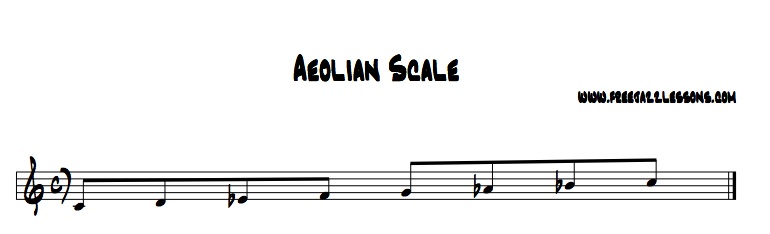
Click to expand scale.
The aeolian mode is sometimes called the natural minor scale. Although it’s not used as often as the dorian mode it still a very cool sound. If you play with it carefully, the half step tension between the 5 and the b6 can create some really interesting colors with your music.
I remember first learning about this scale as a kid playing in my first rock band. We used to jam for hours on the Bob Dylan classic “All Along The Watchtower”. 🙂
(Of course both Jimi Hendrix and Dave Matthews both did famous versions of this song) All the chords to this song are in the aeolian mode.
———————————————–
2. Dorian Mode – Jazz Minor Scale
Music Theory Scale Degrees ( 1, 2, b3, 4, 5, 6, b7)
Click to expand scale.
The dorian mode is often the first scale choice when jazz musicians improvise over a minor chord. If I’m thinking modally I tend to use it quite a bit as well. I
The head of Miles Davis famous song “So What” features the dorian mode. In addition, alot of the jazz improvisation vocabulary features dorian. It’s very beautiful just the like the melodic minor scale!
If you want some more information on how to learn from Miles on this tune then please also check out this Miles Davis lesson. You can also check out this tutorial to learn some dorian chords.
Tips For Practicing These Jazz Minor Scales
1. It’s important that you take these scales in as many keys as possible. You don’t want to be a monster player in the key of C but a hack in the key of B. Learn all your keys. 🙂
2. A good way to sound musical right away with these jazz piano scales is to start working out some short musical sequences and licks built from notes of the scales. Put on the jam track above and use it as a springboard to help you come up with ideas.
3. Still not sure what licks to play? Grab some of the ones I use on the video or learn how to make your own inside The Jazz Masters Method DVD They’re all yours. 🙂
****
 I hope you’ve enjoyed this free jazz piano lesson. Do you like the sound of a jazz minor scale? How do you plan on applying these jazz minor scales to your own music? Please leave a comment below letting us know.
You are welcome to visit this page regularly to practice using the jam track above in this lesson. I would recommend you focus on 1 jazz minor scale per practice session. Master each one of them and then begin to mix them together.
If this is your first time here or a regular reader please don’t be a stranger ! Say hello and leave a comment below.
Also, be sure to subscribe to the email list to receive free jazz lessons in your inbox. It’s quick, easy, and free. The sign up form is on the right side of this page.
P.S: If you want to learn about another very common minor scale then you can also check out this harmonic minor lesson.
