
How To Solo Over the Jazz Standard All The Things You Are.
 Would you like to be able longer jazz licks? Do you feel like your licks sometimes sound like run on sentences?
How do you play those beautiful and long flowing lines that a lot of the great jazz masters play?
You know the ones that always sound good no matter how long they go?
Your Jazz Improvisation Solution
Well, today we are going to focus on a great way to get your jazz lines and phrases to flow better and sound more authentic.
We’re going to do this by talking specifically about a device called an approach pattern.
(Here are some more video lick lessons that demonstrate this concept well Barry Harris Lick, Bebop Piano Lick Lesson , and Turnaround Lick Lesson)
Approach Patterns Explained
(recorded example below)
1. There are lots of ways to play approach patterns but the basic idea is that you have a “target note” or “goal note” that you would lead into by playing a few chromatic notes before hand in order to lead into it smoothly.
2. Using approach patterns really is a fantastic method of delaying your point of resolution.
When you delay your resolutions it give you the opportunity to play longer phrase lengths while still sounding musical.
3. Lets say for example if you are trying to land on the note “E” inside a Cmaj7 chord. You could play 2 chromatic notes below E to lead into….D and D#.
You could also play two chromatics above it to lead into as well…F#, F, and then resolve into the E.
4. I ended up taking a very quick improvised solo on the tune “All The Things You Are”.
I tried using approach patterns for you guys as much as possible so you can hear and see them. (Transcription and recording of the solo below.)
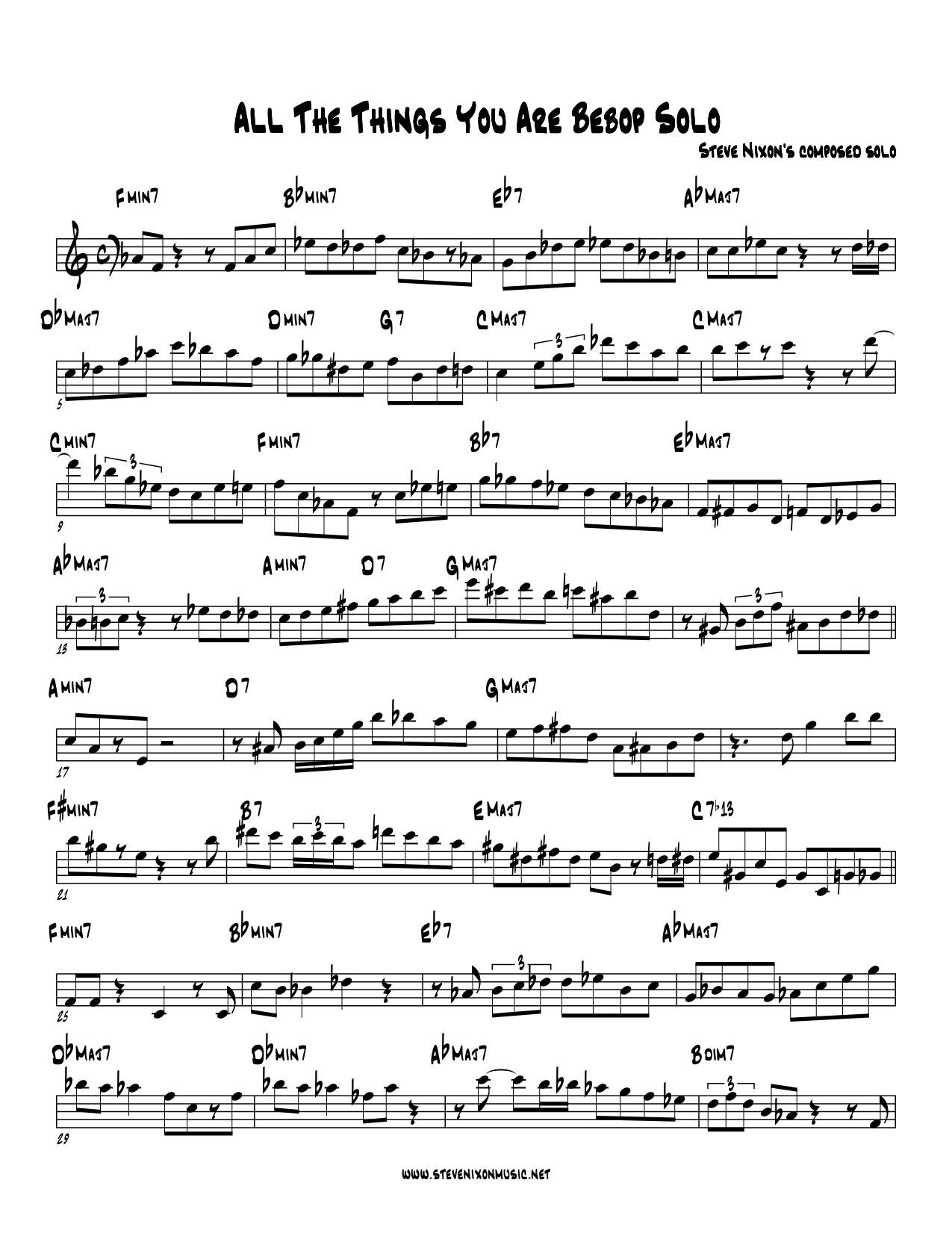
click to expand
Here is a very quick recording that was made of the solo in the lesson. (audio ex. below) All The Things You Are Solo. Take a listen to the solo and try to hear some of the approach patterns I use.
(Tip: print out the solo or open in new browser window above so you can more easily study it).
Hear how they extend lines by delaying resolution notes and adding some really nice chromatic flavor to the solo?
Approach Pattern Examples
Throughout the tune I use approach patterns in almost every measure. Here is just a few examples of many:
1. Measure 2 over the Bbmin7. On beat 1 I play Eb, D, and then finally resolve to my target point Db (which is the third of the chord) on beat 2.
2. Measure 3 to Measure 4. On beat 4 of measure 3 I play Bb, B to lead into C (the 3rd) of Abmaj7
3. Measure 9 to Measure 10. On beat 4 of measure 9 I play Eb, E to lead into the F (root) of the Fmin7 chord.
How To Practice Approach Patterns and Final Thoughts
1. Take one of your favorite jazz standards or a blues and practice targeting chord tones with any of the approach patterns from this solo.
I recommend starting with 2 chromatics below your resolution note. Then, move on to others.
2. As you can see and hear, approach patterns can be started on different beats but for the most part they resolve eventually on the strong beats (1,2,3, or 4).
3. Practice starting your approach patterns on different beats. This concept alone will bring a ton of variety to your solos and licks.
4. Remember to always play with a good swing feel. Great jazz rhythm is absolutely essential if you want to learn how to solo in jazz.
5. If you want to learn more about jazz improvisation techniques and especially approach patterns then I recommend you check out my jazz piano dvd The Jazz Masters Method.
You’ll find over 2 hours of content in there teaching you the amazing art form of jazz improvisation.
**** If you enjoyed this article please sign up for the free jazz lessons mailing list or leave a comment below. ****
