4 Bill Evans Jazz Chords You Need To Know

Bill Evans Jazz Chords

jeffmeshel.com

Here’s a free jazz piano lesson featuring the awesome jazz chords of Bill Evans.

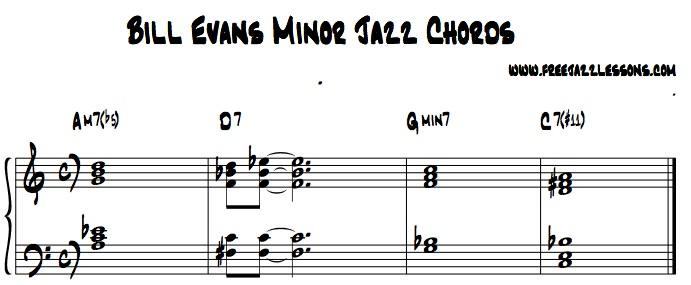
This particular lesson features a ii-V-i-IV (2-5-1-4) chord progression in a minor key.

These beautiful chords are very useful because you can use them in solo jazz piano arrangements and you can also use them to play behind other instrumentalists. They sound sweet too! (Video lesson, notation and tips below.)  

This is the second set of Bill Evans chords in our series.  You can also check out the other Bill Evans chords lesson here.

The best place to start is to watch the video first.
jazz piano chords Bill Evans

2 Take Away Tip For This Jazz Lesson 

1. Bill Evans was a big fan of upper structure triads.  He uses them in every chord in the chord progression.  Upper structure triads are extensions of the harmony (9′s, 11′s, and 13th’s) played in simple triads in the right hand.

  • For example, in measure 1 he plays a G major triad in the right hand over the Amin7(b5) measure.  This G chord functions as the 7,9, and 11 of the Amin7(b5).

  • Another example, in measure 2 he plays a Bb major triad in the right hand over the D7.  The Bb triad functions as the #9, b13, and root of the D7 chord.

  • If you want some more tips to understand how to use extensions on your chords then check out this jazz extensions lesson.

The basic idea is that you can take simple triads you already know and stack them on top of each other to create more complex chords.

2. Notice how the top notes of these chord progression only move by step.  One of the best ways to get smooth sounding chord progressions is to pay attention the voice leading of your top notes.

  • To put it simply….try to create a nice simple melody with the top notes of your chords.  If the top note of your chords moves too much from one chord to another it won’t sound very smooth.

****

I hope you’ve enjoyed this free jazz piano lesson.  Do you like the sounds of these chords? Do you find them useful? Let us know about it by leaving a comment below.  

Also be sure to subscribe to the email list below and/or above to receive free jazz lessons weekly in your inbox.

Steve Nixon is the proud owner of freejazzlessons.com He is a world touring jazz and blues keyboard player and educator.

He is also the author of the brand new Jazz Masters Method , a study of 9 legendary jazz piano players, and the Learn Blues Piano DVD Course


Subscriber Counter
This entry was posted in Chord Lessons, Jazz Blog, Jazz Piano Lessons, Masters of Jazz, Two Handed Comping and tagged , , , , , . Bookmark the permalink.
  • John

    Simple but efficient lesson and sounds great. Thanks again

    • http://www.freejazzlessons.com/ Steve Nixon (freejazzlessons)

      No problem John!  Yeah. Great sounding chords right!

  • http://www.facebook.com/hendrik.deckers Hendrik Deckers

    cool – txs!

    • http://www.freejazzlessons.com/ Steve Nixon (freejazzlessons)

      My pleasure Hendrik.

  • Paulie

    Sincere thanks, takes me a while to really get through this stuff, but it’s priceless.  Have talked to a number of people that saw Bill Evans, what experiences they must have had.

    • http://www.freejazzlessons.com/ Steve Nixon (freejazzlessons)

      Glad you like the chords Paulie. Bill’s stuff is very deep so take your time going through this stuff :)

      I never saw Bill live unfortunately. I wonder if any of the other readers had the pleasure of seeing Bill?

  • Kdiddledesign

    Awesome!! Thanks

  • Paul

    Awesome!! Yeah someone´s already said that, but I don´t care….it is!  More power to your pinkies Steve, keep it coming!

  • Jfmcnichol

    Your explanations are great!
    thanks a lot

  • http://www.facebook.com/bisaga Gary Bisaga

    Steve, this is awesome. I love the way you break down this kind of thing, or the “shell” chords. Really looking forward to getting into playing jazz piano on my new piano.

    • http://www.freejazzlessons.com/ Steve Nixon (freejazzlessons)

      It’s a great feeling to play on a new piano isn’t it?

  • Germán

    This is Awesome!! Great work, sir. This chords really sound great. However, i feel a litte bit confused about the Am7b5, because teachers always told me the half diminished chords are the ones a half step down the root of the major scale. I even remember playing this kind of chord by accident and liking it, but because i couldnt approach it with the theory i learned at the time.I decided to forget about it.  Wich scale/mode would you use to improvise over that first bar?
    I guess you use the locrian mode to play over that Cmajj7, right?
    Thank you very much. Germán

    • http://www.freejazzlessons.com/ Steve Nixon (freejazzlessons)

      Hi German,
        Over the first bar you could use the locrian #2 mode. Over Cmaj7 you could use C Ionian or C Lydian.  Hope this helps!

      • http://www.facebook.com/terry.mcgraw1 Terry McGraw

        If I’m not mistaken, another way to think of a Locrian #2 is the ascending melodic minor of the minor third. e.g.. for a Am7-5, using a C ascending melodic minor

        • http://www.freejazzlessons.com/ Steve Nixon (freejazzlessons)

          That is exactly true. Melodic minor has some AMAZING possibilities and deritives in modern jazz harmony.

  • guest

    very helpful. you are a great teacher! thank you

    • http://www.freejazzlessons.com/ Steve Nixon (freejazzlessons)

      Thanks.

  • Robert

    Thanks for sharing something so wonderful and useful career wise.your explanations are easy to understand.bob

    • http://www.freejazzlessons.com/ Steve Nixon (freejazzlessons)

      Glad you find it useful Robert!

  • John Reynolds

    Thank you so much for these jazz lessons and your precise explanations!  Even these small tips have helped me greatly! 

  • Raymond

    Very kind and generous of you to share your knowledge. Much appreciated.

    • http://www.freejazzlessons.com/ Steve Nixon (freejazzlessons)

      My pleasure Raymond. Welcome to the community here.

  • Abert

     I liked the Bill Evans chords. Next step is to fit them in your own compositions… thats not so easy..

  • Neil

    Great,  thank you very much for sharing on your site.
    good material, many thanks again   Neil

  • Pertti Peussa

    Very useful, could be used in “The Shadow of Your Smile”. Greetings, Pertti.

  • Astamur

     Big thanks for you!!

  • Juergen Hoefner

    Ihave only joined your community recently, but I am really impressed by your lessons. Thank you so much. I am 76 years old and started playing jazz standards 10 years ago.
    Kind regards Juergen